
Roast Beef Cooking Time Calculator
Planning a classic British Sunday roast starts with an accurate roast beef cooking time calculator. Whether you need a dependable beef roast calculator to work out your beef roast cooking time by weight, estimate total roast beef roasting time for topside or sirloin, or use a practical meat roasting calculator with a built-in resting schedule, this tool helps you stay on track.
All calculated timings are estimates. Always follow your butcher's or pack's instructions, ensure every external surface is properly browned, and verify core temperature with a calibrated food thermometer.
Total Cooking Time: 1 hr 25 mins
Start with an initial searing phase at 200°C Fan to caramelise the crust and thoroughly cook all external surfaces. Then drop oven to 160°C Fan for 65 minutes.
Two-Temperature Roasting & Resting Breakdown
At 200°C Fan to brown every outer surface
Turn oven down to 160°C Fan
Carryover heat lifts temp 3°C – 5°C
Food Safety & Thermometer Guidance: Whole, unrolled cuts of beef (such as topside, rib, or sirloin) carry bacteria only on the outer surface; every external surface must be thoroughly cooked and browned to ensure safety. Rolled or tied joints, where external surfaces were rolled inside, must be cooked thoroughly through to at least 70°C for 2 minutes throughout.
Follow your butcher's or pack's instructions and verify core temperature in the thickest part of the joint away from bone.
UK Roast Beef Cooking Times Reference Table
Timings below assume an initial high-heat sear at 220°C (200°C fan / Gas Mark 7) to brown the joint, followed by gentle roasting at 180°C (160°C fan / Gas Mark 4):
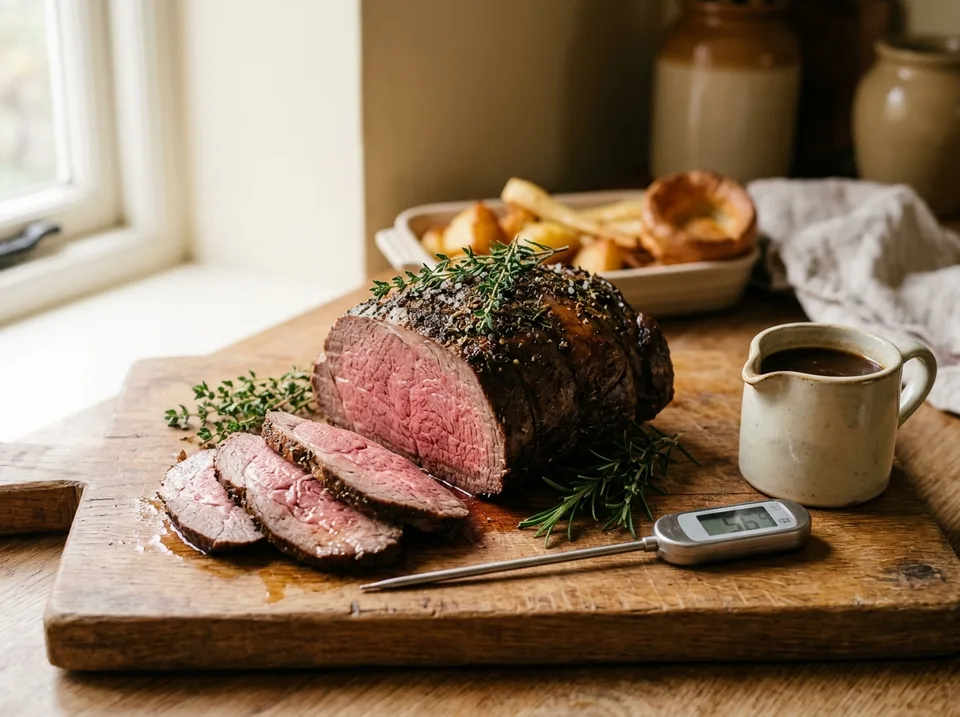
| Doneness | Per 500g (after 20m sear) | Target Core Temp | Internal Centre Appearance |
|---|---|---|---|
| Rare | 15 mins | 52°C – 54°C | Bright red, very soft and juicy |
| Medium-Rare | 20 mins + 5 mins | 55°C – 59°C | Deep pink centre, tender and moist |
| Medium | 25 mins + 10 mins | 60°C – 65°C | Warm pink band through middle |
| Well Done | 30 mins + 15 mins | 70°C – 74°C | Uniformly brown, firm throughout |
Why Resting Your Beef Joint is Non-Negotiable
When beef roasts, heat drives internal juices toward the centre of the meat while muscle fibres contract. If you carve a joint immediately upon taking it from the oven, those delicious juices will spill out onto the board, leaving the meat dry.
Resting the beef on a warm carving board covered loosely with a sheet of foil for 20 to 30 minutes allows the muscle fibres to relax and reabsorb moisture. During this time, carryover heat will also raise the internal temperature by 3°C to 5°C.
Food Safety: Whole Cuts vs Rolled Beef Joints
Under UK Food Standards Agency (FSA) guidance, eligible whole, unrolled cuts of red meat (such as topside, sirloin, and fore-rib) carry harmful bacteria like E. coli only on the exterior muscle surface.
To ensure safety when serving beef rare or medium-rare, every external surface of the meat must be thoroughly cooked and browned. An initial high-heat searing phase helps achieve this, but home cooks should visually verify that all outer surfaces are completely browned.
Critical Difference for Rolled Joints: In boneless rolled and tied beef joints, or mechanically tenderised cuts, external surfaces and bacteria are rolled into the centre. Rolled joints cannot safely be served rare or medium-rare; they must be cooked thoroughly through to the centre (at least 70°C for 2 minutes).