
Ingredient Guides
Butter vs Margarine for Baking: Which Should You Use?
Compare butter and baking margarine for cakes, biscuits, pastry and icing, and learn when each choice makes the most sense for a recipe.
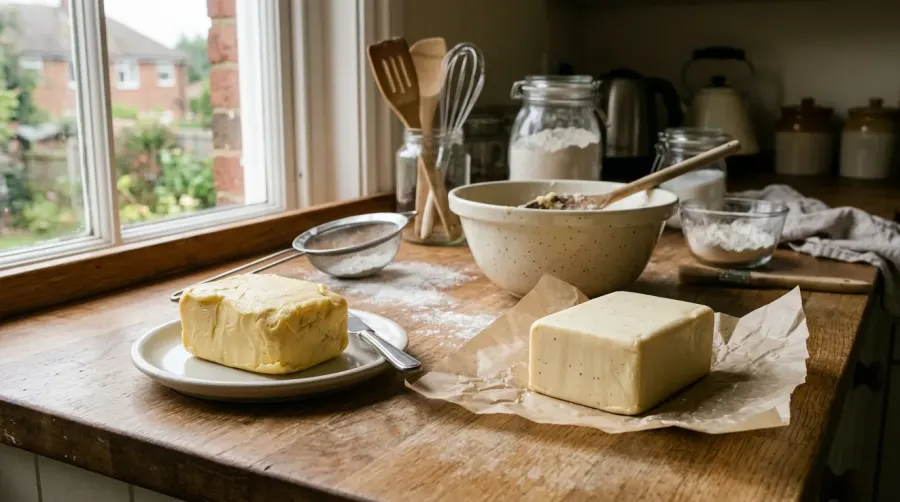
Butter and a suitable baking margarine can both work well in baking, but that does not mean they will behave exactly the same in every recipe.
Butter brings a distinctive dairy flavour and has its own way of softening and melting. A margarine or baking spread designed specifically for baking may be formulated to mix easily and stay workable during cake making.
The exact product matters just as much as the name on the front.
A firm baking block, a soft spreadable tub and a reduced-fat spread can behave very differently in a mixing bowl, even if they sit beside each other in the supermarket fridge.
The difference starts before anything goes into the oven
Baking fats do more than add richness.
They can influence:
- how much air a cake mixture holds
- how easily a dough spreads
- how tender a finished bake feels
- how pastry handles before baking
- the flavour and aroma of the finished food
Butter and baking margarines can differ in firmness, water content, flavour and melting behaviour.
Margarine and spread products also vary considerably between formulations, so two products that look similar in a tub are not necessarily interchangeable.
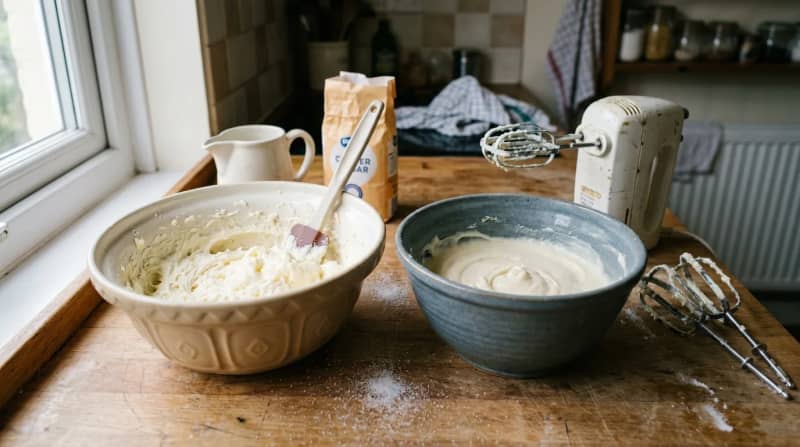
Here is a practical comparison.
| Baking factor | Butter | Suitable baking margarine or baking block |
|---|---|---|
| Flavour | Distinct dairy flavour | Usually milder or more neutral |
| Firmness | Changes noticeably with temperature | Depends on formulation |
| Creaming | Works well when properly softened | Many baking products are designed to mix easily |
| Melting behaviour | Characteristic to butter | Varies between products |
| Product variation | Relatively familiar behaviour | Can differ considerably by product type |
| Particularly useful when | Butter flavour or behaviour matters to the recipe | The recipe was developed for that baking product |
Neither column is automatically better. The useful choice depends on what you are baking.
Butter changes both flavour and texture
Butter is often chosen because its flavour remains noticeable after baking.
That matters particularly in recipes with relatively few strong flavours, such as shortbread, plain biscuits, some pastries and buttercream.
Its temperature also matters in recipes that use the traditional creaming method.
Butter that is very hard and cold does not cream efficiently with sugar. It is harder to incorporate air into the mixture, which can contribute to a denser result.
At the other extreme, butter that has become very warm, shiny or greasy is also difficult to cream properly because it cannot hold the aerated structure as effectively.
For a recipe asking for softened butter, a useful practical check is texture rather than simply how long the butter has been sitting on the worktop. It should give when pressed but still hold its shape.
That does not mean every recipe needs softened butter. Pastry and other methods may deliberately require the butter to be colder.
Follow the method rather than using one butter temperature for every bake.
Salted and unsalted butter can both be used in baking when the recipe allows for them. If a recipe specifies one, following that instruction gives you the most predictable balance of seasoning.
Why baking margarine can work well in cakes
A product designed specifically for baking can be very convenient in everyday cake making.
Some baking margarines and baking spreads remain workable over a wider range of normal kitchen conditions than traditional butter. This can make them convenient in recipes designed around easy mixing or an all-in-one method.
Their flavour is also usually less dominant than butter.
That can suit cakes where other flavours are intended to stand out, such as:
- chocolate
- citrus
- fruit
- spices
- jam and icing
The important qualification is designed for baking.
The fact that a product spreads easily on toast does not automatically mean it is suitable for cake batter.
A soft spread is not the same thing as a baking block
This is one of the most useful distinctions to make before substituting anything.
A soft spread sold in a tub is designed to remain easy to spread, often even when chilled.
That physical behaviour tells you it is not necessarily formulated in the same way as a firm baking block.
Some reduced-fat and spreadable products contain a greater proportion of water and other ingredients relative to fat. That can change the way a recipe behaves.
Depending on the bake, an unsuitable spread may affect:
- batter consistency
- biscuit spread
- pastry handling
- finished texture
The simplest check is the packaging.
If the product says it is suitable for baking, you at least know that baking was considered in its formulation.
If it says that it is intended only for spreading, or specifically advises against baking, use something more appropriate for the recipe.
What works best in a sponge cake?
For an everyday sponge, both butter and an appropriate baking margarine can be reasonable choices.
The recipe should lead the decision.
Butter makes sense when flavour is part of the point
Butter may be the better fit when:
- the recipe was tested with butter
- you want a noticeable buttery flavour
- the method depends on creaming softened butter with sugar
- the cake itself has a fairly simple flavour profile
Baking margarine makes sense when the recipe expects it
A suitable baking margarine or spread may be useful when:
- the recipe specifically calls for one
- the method is designed around easy mixing
- other ingredients provide most of the flavour
- the particular baking product is known to suit cakes
Do not assume that margarine automatically makes a lighter sponge or that butter automatically makes a better one.
Flour, sugar, eggs, raising agents, mixing and baking all influence the final crumb too. Reducing fat or substituting low-fat spreads that have high moisture content can drastically alter crumb softness; if your bakes have turned out tough or lack tenderness, read our troubleshooting guide on Why Is My Cake Dry? Common Causes and Fixes.
Biscuits make the difference easier to notice
Fat plays a particularly visible role in biscuits and cookies because its firmness and melting behaviour influence how the dough spreads in the oven.
If a fat softens or melts sooner, the dough may begin spreading before its structure has fully set.
A firmer fat may hold the original shape for longer.
That still does not mean the fat alone controls biscuit spread.
The result can also be affected by:
- sugar
- flour
- egg
- dough temperature
- chilling
- oven temperature
Butter has another advantage in simple biscuits because its flavour is easy to notice.
In a plain butter biscuit or shortbread-style recipe, replacing the butter changes more than just the mechanics of the dough. It changes one of the main flavours of the finished biscuit.
This is why the more a recipe depends on butter for its identity, the more noticeable a substitution is likely to be.
Pastry depends heavily on the type of fat the recipe expects
Pastry is less forgiving of casual substitutions because the physical condition of the fat can be central to the method.
Some pastry recipes need pieces of cold, firm fat to remain distinct while the dough is handled.
Other pastry methods use softened fat differently.
So the useful rule is not simply "pastry needs cold butter". It is to use the type and temperature of fat specified by the particular pastry method.
Butter is valued in many pastries because it contributes a distinctive flavour as well as affecting texture.
Baking margarine can also work in pastry when the product and recipe are designed for that use.
A soft table spread should not be treated as a direct pastry substitute unless the recipe specifically calls for it.
Buttercream makes the choice especially obvious
In a cake, the flavour of the fat is mixed with flour, eggs, sugar and other ingredients.
In buttercream, it is much more exposed.
That means the flavour, firmness and mouthfeel of the chosen fat are immediately noticeable.
Classic buttercream recipes normally use butter because its flavour is part of the finished icing.
Alternative icings can be made with suitable plant-based fats or other products, but they will have their own flavour and texture.
The most reliable approach is to use the fat the icing recipe was developed around rather than swapping products and expecting an identical result. For a velvety texture without gritty crystals, pair your softened butter with finely milled sugar as explained in our guide on Caster Sugar vs Icing Sugar: What's the Difference?.
Can butter and margarine be swapped in equal amounts?
Sometimes, but it should not be treated as a universal rule.
In a straightforward everyday cake, replacing butter with a suitable baking margarine in the same stated quantity may produce an acceptable result.
That does not mean the finished cake will be identical.
A substitution becomes less predictable when:
- the alternative product has a very different formulation
- the recipe relies heavily on butter flavour
- firmness is important to the structure
- the bake is particularly sensitive to water content
- the fat's melting behaviour affects spreading
Shortbread is a good example.
The flavour and texture rely heavily on the butter itself, so replacing it is a much more noticeable change than replacing butter in a strongly flavoured everyday sponge.
Before substituting, check both the recipe and the label on the product you want to use.
Dairy-free baking needs the same kind of thinking
A plant-based product being dairy-free does not automatically tell you how well it will bake.
A firm plant-based baking block designed for baking may be more suitable for some recipes than a soft table spread.
Check two separate things:
- whether the product meets the dietary requirement you need
- whether the product is actually suitable for the baking method
Those are different questions.
If a recipe has been specifically developed with a particular type of plant-based baking fat, following it is more reliable than treating all dairy-free spreads as interchangeable.
Choose the fat for the bake in front of you
There is no need to pick one permanent winner between butter and margarine.
Instead, look at what the recipe needs.
Victoria-style sponge where flavour matters
Use the fat specified in the recipe. Butter will give a more noticeable dairy flavour if that is part of the result you want.
Everyday sponge written for baking spread
Use a suitable baking spread rather than assuming a random soft tub product will behave the same way.
Shortbread or a simple butter biscuit
Butter usually plays a major role in the intended flavour, so changing it is likely to be obvious.
Pastry
Follow the recipe's choice of fat and its required temperature. Different pastry methods use fat differently.
Buttercream
The fat is one of the main flavours and strongly affects texture, so substitutions are especially noticeable.
The most useful question is not "Is butter better than margarine?"
It is:
What fat was this recipe designed around, and what do I want from the finished bake?
Once you answer those two questions, the choice usually becomes much easier.
Useful Tools for this Guide
- Use Tool: Cups to Grams & Grams to Cups Converter
Cups to Grams & Grams to Cups Converter
Estimate ingredient weights from US, UK and metric cup measures using documented reference weights. Brands and measuring methods can change the result.
- Use Tool: Grams to Teaspoons Converter
Grams to Teaspoons Converter
Convert grams to teaspoons for flour, sugar, butter, salt, and more. Choose your ingredient for quick, accurate UK cooking and baking conversions.