
Ingredient Guides
Plain Flour vs Self-Raising Flour: How to Substitute Them
Learn how to swap plain and self-raising flour while accounting for baking powder, bicarbonate of soda and the raising agents already in a recipe.
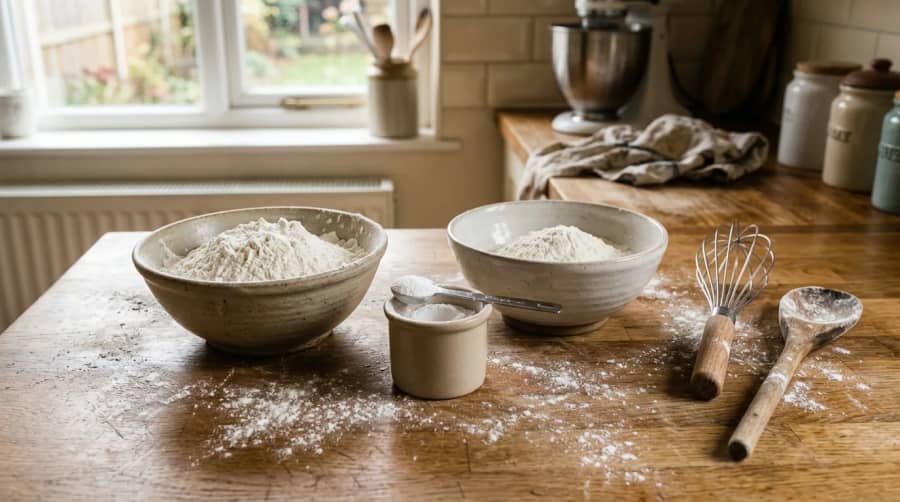
Plain flour and self-raising flour can sometimes stand in for each other, but the direction of the swap matters.
If a recipe asks for self-raising flour and you only have plain flour, you normally need to replace the raising action that is missing.
If the recipe asks for plain flour and you only have self-raising flour, you have the opposite problem. Raising agent is already entering the recipe, so you need to look at everything else in the ingredient list before making the swap.
That is why flour substitution is easier when you think about the whole recipe rather than changing one ingredient name.
What is the practical difference?
Plain flour
UK plain flour does not normally have a chemical raising agent included as part of the flour.
A recipe that needs chemical lift will therefore usually add its raising ingredients separately, such as baking powder or bicarbonate of soda.
Other recipes may rise through yeast, eggs, steam or the way the mixture is prepared.
Self-raising flour
Self-raising flour already contains raising ingredients blended through the flour.
The exact formulation is not identical between every product, which is important when trying to recreate it at home.
You may also see self-rising flour in American recipes. That is related terminology, but formulations and conventions can differ. This guide is written around British plain flour and self-raising flour. If you're adapting American recipes that call for all-purpose flour or self-rising flour, consult our UK to US Baking & Cooking Conversion Guide to convert volumetric cups and terminology accurately.
First, work out which swap you are making
| Recipe asks for | You have | What to do first |
|---|---|---|
| Self-raising flour | Plain flour | Check how much baking powder to add |
| Plain flour | Self-raising flour | Check the recipe's existing raising agents |
| Self-raising flour | Self-raising flour | Follow the recipe |
| Plain flour | Plain flour | Follow the recipe |
The first substitution is normally easier to handle than the second.
Using plain flour when the recipe asks for self-raising
Plain flour can often form the base of a homemade self-raising flour substitute.
The important part is adding an appropriate amount of baking powder and distributing it evenly.
There is not one conversion that matches every commercial flour and every baking powder product exactly.
Check your baking powder packaging first. If the manufacturer gives instructions for turning plain flour into a self-raising substitute, follow those directions.
If the packaging gives no guidance, a commonly used UK rule of thumb is:
2 level teaspoons baking powder per 150 g plain flour
Treat this as a practical starting point rather than a formula that exactly reproduces every bag of commercial self-raising flour.
Once measured, whisk or sift the baking powder thoroughly through the flour before adding it to the wet ingredients. Even distribution is more useful than having concentrated pockets of raising agent in one part of the batter.
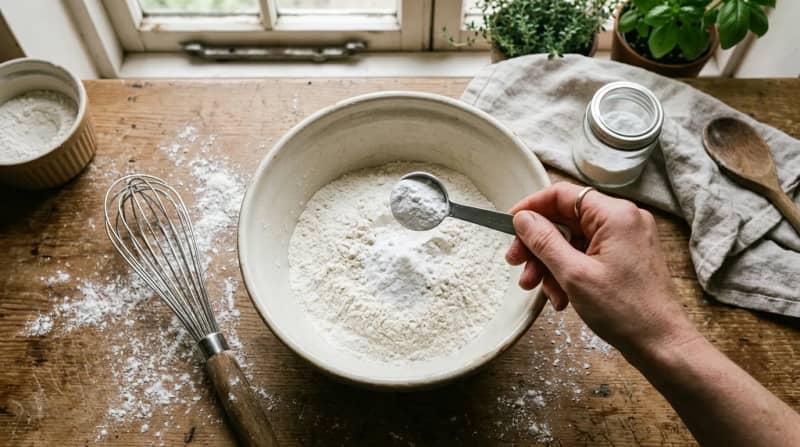
A worked example with 300 g of flour
Suppose a simple sponge recipe asks for:
300 g self-raising flour
and your baking powder does not give its own flour-conversion instructions.
Using the general 2 teaspoons per 150 g guideline:
300 ÷ 150 = 2
So:
2 × 2 teaspoons = 4 level teaspoons
You would therefore combine:
- 300 g plain flour
- 4 level teaspoons baking powder
Whisk or sift them together thoroughly before using the mixture in place of the self-raising flour.
This calculation only applies when you are deliberately using that particular guideline.
If the instructions on your baking powder specify a different quantity, use the product instructions instead. If you don't have digital kitchen scales ready on the counter, our guide on how to measure flour without scales walks through reliable volume and spooning techniques.
Keep separately listed raising agents in view
Suppose the original recipe asks for:
- self-raising flour
- plus extra baking powder
That does not automatically mean the recipe contains too much raising agent.
The additional baking powder may be intentional because the recipe was developed to need more lift than the self-raising flour provides on its own.
If you replace the self-raising flour with plain flour, you need to think about both parts:
- the raising action that was originally built into the self-raising flour
- the extra baking powder separately listed in the recipe
Do not accidentally replace one and forget the other.
The same care applies if the recipe separately includes bicarbonate of soda.
What if bicarbonate of soda is already in the recipe?
Do not automatically remove bicarbonate of soda just because you are adding baking powder to plain flour.
Bicarbonate may have been included for a specific reason, particularly when the recipe contains ingredients that provide enough acidity for it to react with.
Examples can include ingredients such as:
- buttermilk
- yoghurt
- lemon juice
- certain syrups or other acidic ingredients
The balance depends on the actual recipe.
Baking powder and bicarbonate of soda are not simply two names for the same ingredient. To understand how each raising agent functions and why some recipes require both, read our detailed guide on Baking Powder vs Bicarbonate of Soda: What's the Difference?.
Using self-raising flour when the recipe asks for plain flour
This substitution needs more caution.
Self-raising flour brings raising agents into a recipe that was written for flour without them.
If the original recipe already contains baking powder or bicarbonate of soda, using self-raising flour without considering those ingredients can increase the total raising power beyond what the recipe was designed around.
That may alter:
- how quickly the mixture rises
- the size and evenness of air pockets
- the finished crumb
- the shape of the bake
In some recipes, too much raising agent can contribute to a rapid rise followed by loss of structure.
The effect is recipe-specific, so there is no sensible rule that says you can always use self-raising flour and simply remove a certain number of teaspoons of baking powder.
Some recipes are easier to adapt than others
A straightforward everyday cake with a simple raising system may be easier to adjust than a recipe whose structure depends on very precise proportions.
Examples that may be more forgiving include some:
- simple sponge cakes
- muffins
- traybakes
- scones
Even with these, read the full ingredient list first.
"Easier to adapt" does not mean every substitution will produce exactly the same result.
When plain flour is there for a reason
There are also recipes where adding an unplanned raising agent can work against the texture you want.
Shortbread and some biscuits
Many are intended to stay relatively compact rather than rise like a sponge.
Using self-raising flour where plain flour was specifically chosen can change the texture or spread.
Pastry
Pastry structure is usually built through flour, fat, liquid and handling rather than relying on cake-style chemical lift.
Do not assume self-raising flour is a direct replacement unless the particular recipe calls for it.
Bread
Most traditional bread recipes use yeast as their main raising system.
That is different from turning plain flour into self-raising flour with baking powder.
Brownies
Many brownie recipes deliberately aim for a dense or fudgy texture.
Adding raising action that was never part of the recipe can shift that result.
None of these examples means self-raising flour can never appear in those types of recipes. It means the recipe should decide, rather than the ingredient you happen to have available.
Baking powder and bicarbonate do different jobs
Baking powder contains both alkaline and acidic components needed for its chemical raising action.
Bicarbonate of soda is an alkaline ingredient and normally needs the right acidic ingredients in the mixture to react effectively.
Changing one for the other without understanding the rest of the recipe can affect:
- rise
- flavour
- browning
- texture
So if a recipe already has a carefully specified combination of plain flour, baking powder and bicarbonate, it is better not to replace the flour casually.
More raising agent does not mean a taller, better cake
It is easy to assume that extra baking powder must create extra lift.
Cake structure does not work quite that simply.
If the batter produces gas faster than its developing structure can support, the crumb can become coarse or uneven. In some recipes, the cake may rise strongly before losing support and sinking.
Excess raising agent can also affect flavour.
The exact result depends on the recipe and on how large the excess is, but the useful lesson is simple: measure raising ingredients rather than adding a little extra for luck. Excess chemical raising agents can cause a cake to expand prematurely before its crumb sets, leading to a collapsed centre; if you've encountered this problem, see our troubleshooting guide on why cakes sink in the middle.
A quick decision flow while you are baking
The recipe wants self-raising flour, but you have plain
- Check whether your baking powder packaging gives a flour-conversion instruction.
- If it does, follow that instruction.
- If it does not,
2 level teaspoons per 150 g plain flouris a commonly used UK starting point. - Whisk or sift the baking powder evenly through the flour.
- Keep separately listed raising ingredients unless the recipe or a tested substitution specifically tells you to change them.
The recipe wants plain flour, but you have self-raising
- Read the entire ingredient list.
- Check for baking powder and bicarbonate of soda.
- Consider whether the recipe is deliberately meant to stay dense, flat or precisely structured.
- Do not assume there is one universal amount of raising agent you can simply remove.
- If the raising system is central to the recipe, using plain flour is the more predictable choice.
Read the whole recipe before changing the flour
The safest flour substitution starts with one question:
Where is this recipe supposed to get its rise from?
If the answer is self-raising flour, plain flour plus an appropriate amount of baking powder can often replace it.
If the recipe was deliberately written with plain flour, look at the rest of its raising system before bringing self-raising flour into the mixture.
That small check is more useful than treating plain and self-raising flour as automatic substitutes.
Useful Tools for this Guide
- Use Tool: Cups to Grams & Grams to Cups Converter
Cups to Grams & Grams to Cups Converter
Estimate ingredient weights from US, UK and metric cup measures using documented reference weights. Brands and measuring methods can change the result.
- Use Tool: Grams to Teaspoons Converter
Grams to Teaspoons Converter
Convert grams to teaspoons for flour, sugar, butter, salt, and more. Choose your ingredient for quick, accurate UK cooking and baking conversions.