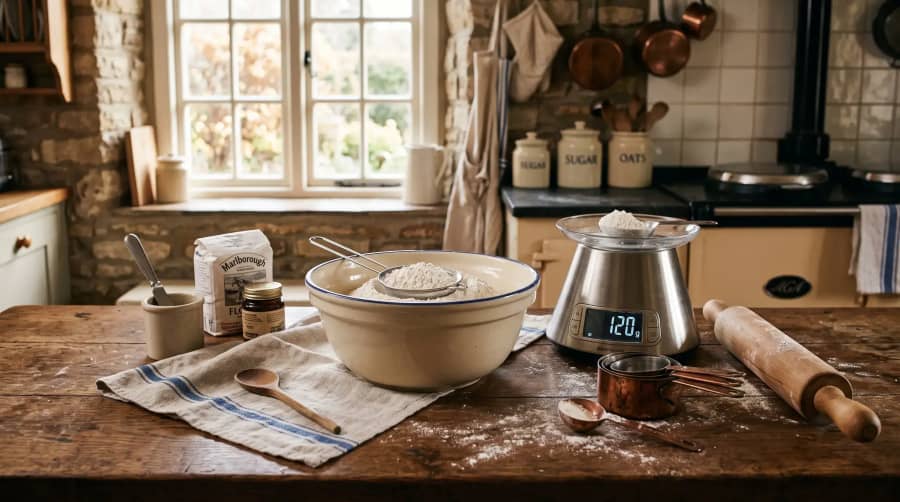
The Ultimate UK to US Baking & Cooking Conversion Guide: Oven Temps, Ingredient Densities, and Measuring Rules
Welcome to My Kitchen Table
Pull up a chair and put the kettle on, because I want to tell you about the worst sponge cake I ever made.
It was years ago, when I first started experimenting with American baking recipes alongside my usual British favourites. A friend from Ohio sent me her grandmother's yellow cake recipe, and I was so excited to try it. I scooped my flour straight from the bag with a measuring cup, packed my brown sugar down like she probably did, and baked it exactly as written. What came out of my oven was heavy, dry, and about as far from a light American layer cake as you can get. I sat on my kitchen floor and genuinely wondered what had gone wrong.
I hadn't lost my touch. I'd lost the translation.
That cake taught me something I now tell every reader of Our British Kitchen: American recipes and British recipes speak two completely different measuring languages. One is built on volume (cups, spoons, sticks), and the other is built on weight (grams, kilograms). They are not interchangeable just because a recipe "looks" the same on the page.
This is what I call the Atlantic Baking Gap, and it's the single biggest reason home bakers on both sides of the ocean end up with disappointing results. A cup of flour can weigh anywhere between 120 grams and 150 grams depending on how it was scooped. That's not a small rounding error. That's the difference between a cloud-like sponge and a dense, sad brick.
So today, over this cup of tea, I'm going to walk you through everything I've learned about converting between British and American baking, properly, scientifically, and without the guesswork that ruined my poor cake all those years ago.
Section 1: Oven Temperature & Heat Transfer Master Class
Let's start with the oven, because this is where I see the most confusion, and honestly, where the most burnt biscuits happen.
British recipes love to throw around "Gas Mark 4" or "180°C fan" as if everyone in the world grew up with a gas cooker in their kitchen. American recipes stick to Fahrenheit almost exclusively. If you're converting a recipe without understanding what each of these numbers actually means, you're baking blind.
Here is the full conversion table I keep taped inside my cupboard door:
| Gas Mark | Conventional Oven (°C) | Fan Oven (°C) | Fahrenheit (°F) | Description |
|---|---|---|---|---|
| 1 | 140°C | 120°C | 275°F | Very low, slow cooking |
| 2 | 150°C | 130°C | 300°F | Low |
| 3 | 165°C | 145°C | 325°F | Moderately low |
| 4 | 180°C | 160°C | 350°F | Moderate (most common) |
| 5 | 190°C | 170°C | 375°F | Moderately hot |
| 6 | 200°C | 180°C | 400°F | Hot |
| 7 | 220°C | 200°C | 425°F | Very hot |
| 8 | 230°C | 210°C | 450°F | Very hot |
| 9 | 240°C | 220°C | 475°F | Extremely hot |
Keep that table close by, because you'll reach for it constantly.
Fan Ovens Explained Simply
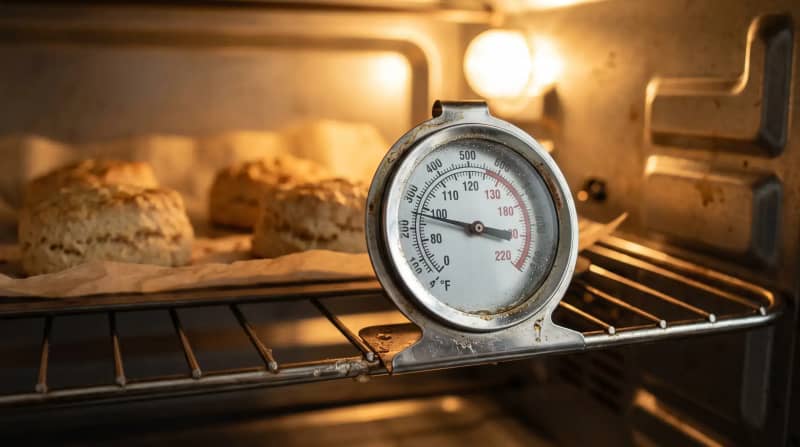 Oven thermometer checking accurate temperature for fan oven conversions
Now, here's the part most conversion charts skip entirely: why does a fan oven need a lower temperature than a conventional one in the first place?
Think about it like this. A conventional oven heats the air around your food, but that air mostly just sits there, gently rising and settling. A fan oven, on the other hand, has a small fan at the back constantly circulating hot air around every surface of whatever you're baking. That moving air strips away the thin layer of cooler air that naturally clings to your cake tin or your baking tray, which means heat reaches the food faster and more evenly.
The catch is that all that moving air also pulls moisture out of your food faster. This is brilliant for things like roast potatoes (that's how you get proper crispy edges), but it can be a real problem for delicate bakes like meringues or soufflés, which can dry out or crack if the airflow is too aggressive. That's exactly why fan ovens are typically run about 20°C cooler than conventional ovens for the same result. You're not cooking food less; you're accounting for the fact that moving air transfers heat more efficiently.
The Golden "20°C / 15-Minute Rule"
If you're working from an American recipe written for a conventional oven and you only have a UK fan oven, here's the practical rule I give my readers, and it has never let me down:
- Take the Fahrenheit temperature and convert it to Celsius using the conventional column above.
- Subtract roughly 20°C to get your fan oven equivalent.
- Check your bake about 15 minutes earlier than the American recipe suggests, because fan ovens often cook faster even at the lower setting.
- Use visual and physical cues rather than the clock alone: a skewer coming out clean, a cake springing back when gently pressed, or a loaf sounding hollow when tapped on its base.
Elowen's Kitchen Tip: Never trust the little dial on the front of your oven completely. Ovens drift in temperature over years of use, sometimes by 10 to 15 degrees. Buy yourself a simple oven thermometer and hang it from the middle rack. It costs less than a bag of flour and it will save you more bakes than any conversion chart ever could.
One more thing worth mentioning here: rack position matters just as much as temperature, and it's something conversion charts almost never talk about. In a fan oven, the circulating air makes heat far more even from top to bottom, so the middle rack is usually a safe default for almost everything. In a conventional oven, heat tends to be strongest near the element, whether that's at the top or bottom, so a cake placed too close can brown before its center sets. If you're converting a recipe written for one oven type and baking it in the other, keep your tray or tin roughly in the middle of the oven unless the recipe specifically tells you otherwise.
Section 2: Ingredient Density & Moisture Matrix
This is where I really want you to slow down, because ingredient conversion is where the science actually lives.
Table 1: Flours & Starches (Cups to Grams)
| Ingredient | 1 US Cup (spooned & leveled) | 1 US Cup (scooped, packed) |
|---|---|---|
| Plain Flour (All-Purpose) | 120g | 145-150g |
| Self-Raising Flour | 115g | 140g |
| Strong Bread Flour | 125g | 155g |
| Cornflour (Cornstarch) | 110g | 130g |
Table 2: Sugars & Sweeteners
| Ingredient | 1 US Cup |
|---|---|
| Caster Sugar | 200g |
| Granulated Sugar | 200g |
| Dark Muscovado Sugar | 220g (packed, sticky and dense) |
| Icing Sugar (Powdered Sugar) | 120g |
Table 3: Fats & Dairy Liquids
| Ingredient | UK Measure | US Measure |
|---|---|---|
| Butter | 250g block | 2 sticks (1 cup) |
| Butter | 1 tablespoon | 14g (roughly 1 UK tbsp) |
| Double Cream | 1 UK pint (568ml) | Closest match: US Heavy Cream, slightly higher fat than US "heavy whipping cream" |
| Whole Milk | 1 UK pint (568ml) | 2.4 US cups |
A quick but important note on butter: American butter sticks are usually marked with tablespoon lines right on the wrapper, which is genuinely a lovely system. British butter comes as a solid 250g block with no markings at all, so if you're working from a US recipe that calls for "6 tablespoons of butter," you'll want to know that works out to roughly 85g. I keep a small kitchen scale by my butter dish specifically for this reason.
The Great Flour Cup Trap
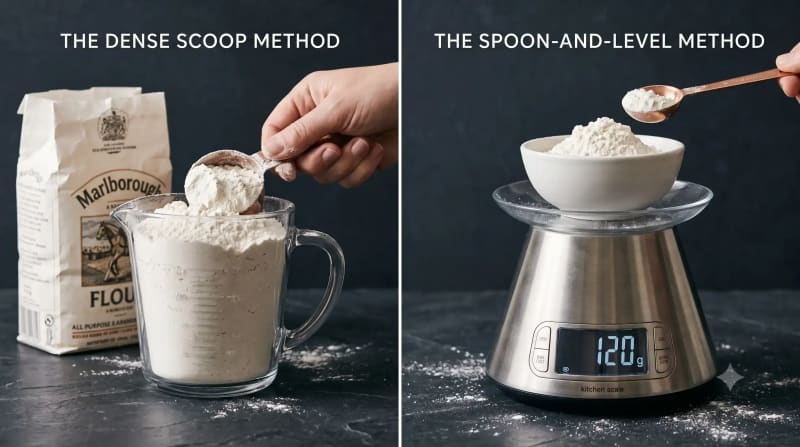 Comparing scooped cup of flour weight versus weighed grams for baking precision
Now let's talk about the mistake that ruined my Ohio yellow cake, because I promise you it is still ruining bakes in kitchens all over the world right now, as we speak.
When you scoop a measuring cup directly into a bag of flour, you're forcing the cup down into compacted flour and dragging it back out overflowing. The flour particles get pushed together, air pockets disappear, and you end up cramming far more flour into that cup than the recipe writer ever intended. This is how a single cup can swing from 120g to 150g, a difference of up to 30 grams from the exact same cup and the exact same flour.
Thirty grams doesn't sound dramatic until you understand what excess flour does structurally. Flour contains proteins that form gluten when mixed with liquid. Too much flour means too much gluten development relative to your fat and liquid, which tightens the crumb structure of your bake. Instead of a soft, open sponge that yields easily to a fork, you get something dense, tight, and often slightly dry, exactly what happened to my poor cake.
The proper technique, the one professional bakers actually use, is to spoon the flour lightly into the measuring cup until it's heaped above the rim, then level it off with the flat edge of a knife without pressing down or tapping the cup. No compacting, no shaking, no forcing.
Elowen's Kitchen Tip: For best results, we recommend using a digital kitchen scale rather than cups. Whether you are baking your grandma favourite cake, or a birthday cake; weighing the ingredients delivers more accurate results. This is why professional bakers measure by weight, always.
Section 3: The UK vs US Culinary Dictionary
Beyond measurements, there's a whole vocabulary gap that trips people up just as often. Let me clear a few of these up properly.
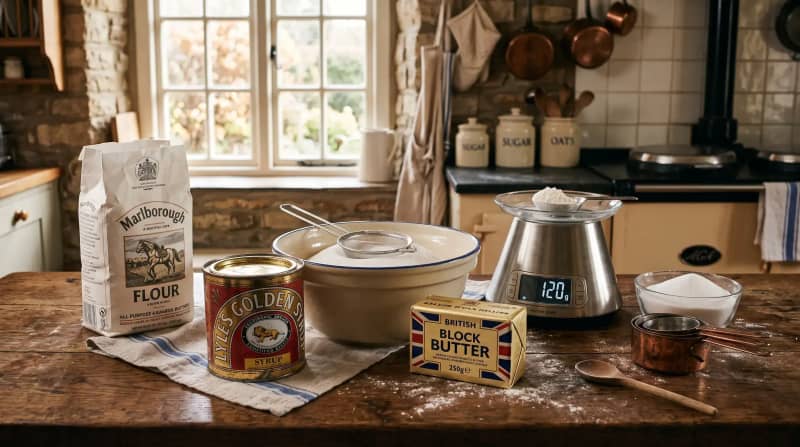 British baking ingredients including caster sugar, golden syrup, and plain flour
Plain Flour vs All-Purpose Flour: These sound identical but aren't quite the same product. British plain flour is milled from softer wheat and tends to sit around 9 to 11% protein. American all-purpose flour is milled from harder wheat varieties and usually runs closer to 10 to 12% protein. That extra protein means more gluten potential, which is part of why American cakes made with UK plain flour can occasionally come out slightly more tender than the original recipe intended, and vice versa when using US all-purpose flour in a delicate British sponge.
Caster Sugar vs Superfine Sugar: Good news here, these are essentially the same thing by two different names, and both are genuinely worth seeking out rather than substituting with regular granulated sugar. The smaller crystal size dissolves far more quickly, which matters enormously when you're whipping egg whites for a meringue or creaming butter and sugar together for a cake batter. Finer sugar means fewer undissolved granules, which means a smoother, more stable structure.
Bicarbonate of Soda vs Baking Soda: No difference at all here, just two names for the exact same raising agent (sodium bicarbonate). Don't let the different name fool you into thinking you need to hunt down something special.
Golden Syrup & Dark Treacle vs US Corn Syrup or Molasses: These ingredients are the same but also certainly not, even though we treat them as if they were. Golden syrup is light, golden brown syrup made from sugar cane with a gently caramel flavor. There is no direct American equivalent, but light corn syrup with a dash of maple syrup makes for an acceptable substitute. The darkest treacle is closest to blackstrap molasses. Its flavour is robust, but it tends to be lower in bitterness than strong American molasses. The wrong one can alter the sweetness, taste and hue of your recipe.
Icing Sugar vs Confectioners' Sugar: Another pair that's simply two names for one product, both finely ground sugar with a touch of cornflour mixed in to stop it clumping. No conversion needed here beyond weight, so this is one small mercy in an otherwise confusing dictionary.
Scones vs Biscuits: Not strictly a baking measurement issue, but worth flagging since it causes genuine confusion in recipe comments sections. A British scone and an American biscuit are close cousins, both small, soft, quick breads leavened with baking powder rather than yeast, but they're seasoned and served quite differently. Keep this in mind if a recipe title mentions one and the method looks suspiciously like the other; you're very likely reading the right thing under an unfamiliar name.
Section 4: Baking Tins & Equipment Calculations
Tin shape matters more than most recipes ever admit.
If you're swapping a round cake tin for a square one, remember that a square pan of the same width actually holds more batter and has different heat distribution, since a square tin has corners that receive more direct heat than the center. As a general guide, an 8-inch round tin and a 7-inch square tin hold roughly the same volume of batter, so that's the closest practical swap. When moving from round to square with no size adjustment, keep an eye on your bake from about 5 to 10 minutes earlier than the recipe states, since those corners can brown before the center has fully set.
On the liquid measuring side, there's a sneaky trap waiting in every recipe that mentions "fluid ounces." A UK (Imperial) fluid ounce is about 28.4ml, while a US fluid ounce is about 29.6ml. It's a small gap on its own, but once you're measuring a full pint, the difference adds up: a UK pint is 568ml, while a US pint is only 473ml. If you've ever wondered why a British recipe seems to use "more" liquid than an American one for what looks like the same quantity, this is very often why.
Section 5: Troubleshooting & Getting It Right Every Time
Even with every table and rule in this guide, mistakes still happen, so let's walk through the most common ones I hear about from readers, and how to rescue your bake when they do.
Mistake 1: Using cup measurements for a British recipe. If a recipe was developed in grams, convert it properly before you start rather than guessing your way through with cups. Undermeasuring flour by even 20g can leave a cake unable to hold its shape.
Mistake 2: Ignoring the fan oven adjustment. Baking a US recipe at its original Fahrenheit-converted temperature in a fan oven almost always leads to a dry, over-browned result. Always apply the 20°C reduction.
Mistake 3: Substituting bicarbonate of soda for baking powder (or the reverse). These are not the same. Bicarbonate needs an acidic ingredient to activate, while baking powder already contains its own acid. Swapping them without adjusting the rest of the recipe can leave your bake flat or give it a metallic aftertaste.
Mistake 4: Treating double cream and heavy cream as identical. Double cream has a higher fat content, which means it whips up thicker and more stably. If a US recipe calling for heavy cream seems runnier than expected once whipped, this fat difference is usually why.
Mistake 5: Not accounting for pint size differences. As mentioned above, a pint in the UK is not equal to a US pint. Always confirm what a recipe is referring to before pouring.
Need instant precision? Try our live Cups to Grams Converter Tool any time you're staring at a recipe and doing mental maths at the kitchen counter. It takes the guesswork out completely, and I use it myself more often than I'd like to admit.
Baking across the Atlantic doesn't have to be a guessing game. Once you understand that it's not just about changing numbers, but about weight and volume, moving air and still air, and different types of wheat, everything starts to make sense. That's when baking feels much easier, and your results become more consistent and turn out well more often.
Now go put the kettle on again, get your scales out, and give that recipe another go. I promise it'll turn out better this time.