
Baking Guides
How to Measure Flour Without Scales: Easy UK Methods
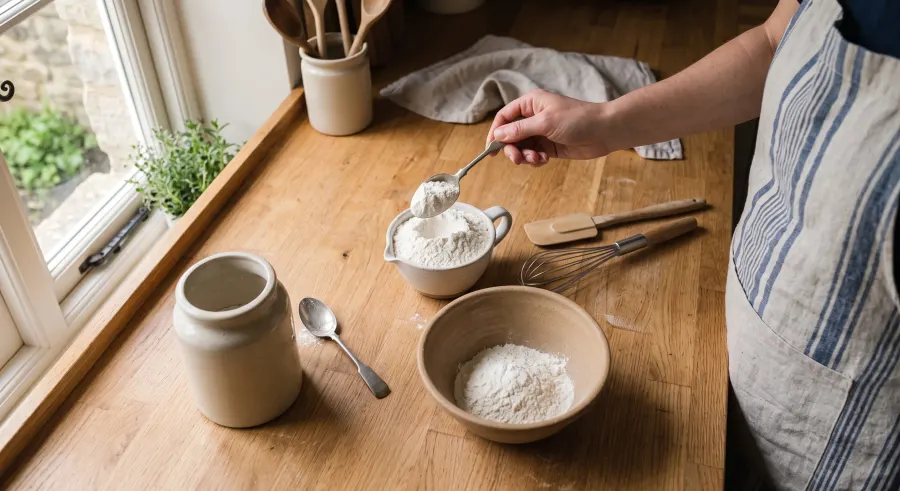
Kitchen scales are the most consistent way to measure flour for baking because grams measure the actual weight of the ingredient. Cup and spoon measurements measure volume instead, so the amount of flour you end up using can change depending on how loosely or firmly it is filled.
If you do not have scales, you can still measure flour reasonably consistently. The best approach depends on what the recipe gives you: cups can work well when the recipe already uses cups, tablespoons are useful for smaller amounts, and an ingredient-specific conversion can help when you need to work from grams.
The important part is to measure gently rather than packing flour into the container.
Best accuracy: Use grams and kitchen scales whenever possible. If you need to measure flour by volume, use a proper measuring cup or spoon, fill it gently and level it rather than compacting the flour.
What Is the Best Way to Measure Flour Without Scales?
If scales are not available, use the method that best matches the recipe.
- If the recipe already gives cups: use a proper dry measuring cupg cup and follow the same cup standard intended by the recipe.
- For smaller amounts: use standard measuring tablespoons or teaspoons where practical.
- If the recipe gives grams: use a reliable flour-specific conversion to work out the corresponding volume before measuring.
- If you have no measuring cup: a container with a known volume can be used only after you know what volume of flour the recipe requires.
These methods are less repeatable than weighing because flour can settle and compact.
Avoid assuming that any mug, glass or teacup equals one measuring cup. Household containers vary considerably in capacity.
How to Measure Flour with a Cup
If you're learning how to measure flour with a cup, the way you fill it matters.
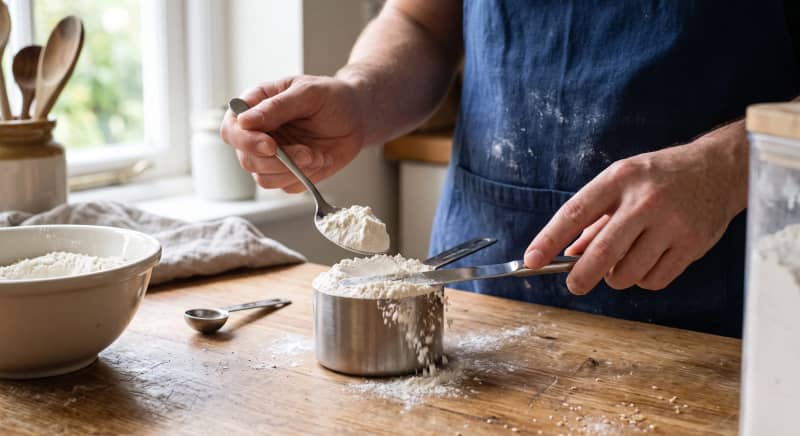
For a spoon-and-level measurement:
- Stir or fluff the flour gently to loosen flour that has settled in the bag or container.
- Spoon the flour into a dry measuring cup.
- Do not press it down, tap the cup or shake it to make more flour fit.
- Continue adding flour until the cup is slightly overfilled.
- Sweep a straight edge across the top to remove the excess.
Scooping the measuring cup directly through the flour can compress it as the cup fills. That may leave you with considerably more flour than a gently filled and levelled cup.
One more detail matters: a cup is not exactly the same volume in every measurement system.
American, metric and older Imperial cup measurements differ, so if the original recipe uses cups, check which standard it was written for rather than assuming every cup measure is identical.
How to Measure Flour with Tablespoons
Standard measuring tablespoons can be useful when you only need a small quantity of flour or do not have a full set of cup measures.
Use proper measuring spoons rather than an ordinary spoon from the cutlery drawer.
For the most consistent result:
- loosen the flour first
- fill the tablespoon gently
- do not press the flour down
- level the top with a straight edge
- use level tablespoons unless the recipe specifically says otherwise
Avoid relying on one universal statement such as “one tablespoon of flour always weighs X grams”. The amount can vary with the type of flour and how densely it has been filled.
For a large flour quantity, measuring tablespoon after tablespoon is also cumbersome and increases the chance of losing count. A cup measure or a flour-specific conversion is usually more practical.
How to Measure Flour Without Scales or Cups
If you need to measure flour without scales or cups, a household container can only be useful if you know its actual capacity.
For example, you might have a small container that you have accurately established holds 125ml.
Knowing that volume allows you to use it as a repeatable volume measure. It does not, by itself, tell you how many grams of flour the container holds.
If your recipe is written in grams:
- identify the type of flour
- use a reliable ingredient-specific conversion to convert the required grams into an appropriate volume
- check which cup or volume standard the conversion uses
- then measure that volume with your known-capacity container as closely as practical
If the recipe is already written in cups, first establish what cup standard the recipe uses and work out what fraction or multiple of that volume your container represents.
Avoid estimating flour with handfuls, fistfuls or an unmeasured mug. Those methods are too inconsistent for most baking.
Why Scooping Flour Can Give You Too Much
Flour contains plenty of air between its particles.
When a cup is pushed directly into a bag or storage container, the flour can become more tightly packed. The same cup therefore holds more flour by weight than it would if the flour were gently spooned in.
Too much flour can contribute to:
- a dry cake
- a denser crumb
- stiff cake batter
- dry or difficult dough
- biscuits or cookies that spread differently from intended
Those problems can have other causes too, so excess flour is not automatically the explanation for every dry or dense bake.
It is simply one common variable that is easy to control.
Does the Type of Flour Matter?
Yes.
Plain flour, bread flour, wholemeal flour and other flour types do not necessarily have identical bulk density or particle characteristics. How they settle in a cup can therefore differ.
This is why it is better to select the actual ingredient when using a conversion rather than relying on a single “one cup of flour” figure for every type of flour.
The recipe source matters as well. One recipe developer's stated cup weight may differ from another's because their measuring method and cup standard may not be identical.
If the recipe supplies both grams and cups, use the recipe's own gram measurement where possible.
Quick Flour Measuring Guide
| Method | Best For | Main Limitation |
|---|---|---|
| Kitchen scales | Most baking | Requires working scales |
| Dry measuring cup | Recipes already written in cups or converted carefully | Result varies if flour is packed or the wrong cup standard is used |
| Measuring tablespoons | Small quantities | Slow and less practical for large amounts |
| Known-volume container | Backup when no standard cup is available | Requires the correct flour conversion and known container volume |
How to Measure Flour Correctly for Baking
For more consistent flour measurements:
- weigh in grams whenever you can
- use the flour type specified by the recipe
- check the cup standard when following a cup-based recipe
- loosen settled flour before measuring by volume
- spoon flour gently into a cup rather than packing it down
- level the top instead of leaving a heap
- use standard measuring spoons rather than ordinary cutlery
- use level spoonfuls unless the recipe says otherwise
- avoid switching between several measurement systems unnecessarily
The aim is consistency. If you measure flour differently each time, even a good recipe becomes harder to reproduce.
Can You Convert Grams of Flour to Cups?
Yes, but grams and cups measure different things.
Grams measure mass, while cups measure volume. To convert accurately, you need both the ingredient and the cup standard.
Our Cups to Grams Converter can convert in either direction for flour and other baking ingredients and lets you choose the appropriate cup standard.
If you're converting a recipe that already provides its own gram and cup measurements, favour the recipe author's stated conversion rather than replacing it with a different generic value.
Frequently Asked Questions
How can I measure flour without scales?
If using cups do not simply dip into flour, use a proper dry measurin Regular measuring spoons can suffice for small amounts. If grams are given in the recipe, apply a flour conversion before measuring by volume.
Can I measure flour with tablespoons?
Yes, particularly for smaller quantities. Measure using standard level measuring tablespoons and gently fill rather than packing the flour down.
How to Measure FLOUR without scales or cups?
Well, use a container only if its volume is known rather than work from an estimate based on flour specifics. A random mug or glass of unknown size is not a reliable replacement for measuring cups.
For example, does one cup of flour always weigh the same?
No. The actual weight varies with the type of flour, how it is filled and what cup standard you are using.
Is weighing flour better than using cups?
Generally, yes. Flour settling, packing and differences in the technique for volume-measuring flour leads to much variation that grams helps avoid.
The Bottom Line
When it comes to precision baking, weighing flour in grams is still what you want (those are the most consistent results), but not having a scale should never mean giving up on your recipe altogether.
If it is measured in cups, and does not state otherwise use the cup standard of your recipe to spoon-and-level gently. Standard measuring spoons come in handy for small amounts. If you are measuring from grams first, then convert the flour to volume using that specific flour before rushing for a cup or any known-volume container.
However you do it, do not pack down the flour. Having a consistent way to measure gives you so much better odds of making sure the balance of your recipe turns out right.
Useful Tools for this Guide
- Use Tool: Cups to Grams & Grams to Cups Converter
Cups to Grams & Grams to Cups Converter
Estimate ingredient weights from US, UK and metric cup measures using documented reference weights. Brands and measuring methods can change the result.
- Use Tool: Grams to Teaspoons Converter
Grams to Teaspoons Converter
Convert grams to teaspoons for flour, sugar, butter, salt, and more. Choose your ingredient for quick, accurate UK cooking and baking conversions.