
Baking Guides
Why Does My Cake Sink in the Middle? 7 Common Causes
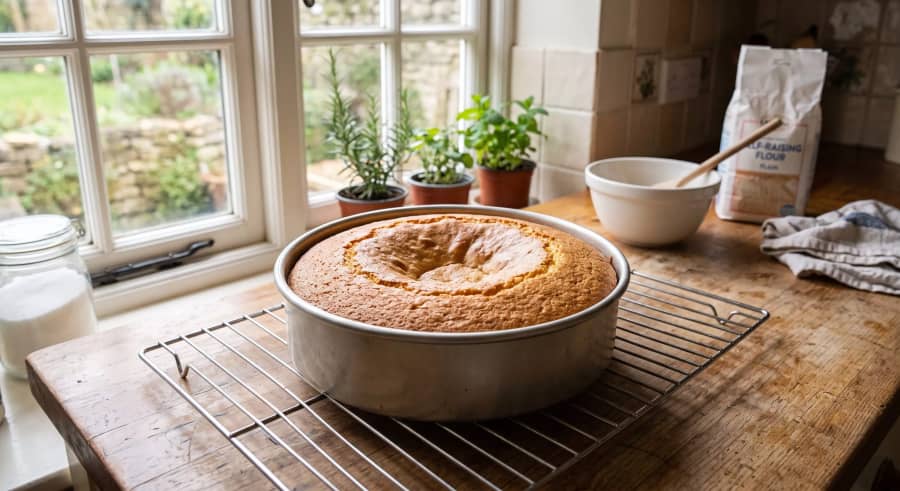
A slight dip in the centre of a cake is not always a problem. Some bakes naturally settle a little as they cool. A deep hollow, especially when the middle is wet, gummy or noticeably lower than the edges, usually means something disrupted the cake's rise or structure during baking.
If you're wondering why does my cake sink in the middle, there is rarely one answer that fits every bake. Underbaking is a common cause, but oven temperature, raising agents, mixing, tin size and changes to the ingredient balance can all play a part.
The clues are often in what the cake looked like before it sank and when the collapse happened.
Quick check: If the centre is wet or gummy, check for underbaking first. If the cake rose very high and then dropped, check the oven temperature, raising-agent quantity and recipe balance.
Why Does a Cake Sink in the Middle?
A cake needs its rise and its structure to develop at roughly the right pace.
As the batter heats, gases produced by raising agents expand and moisture turns to steam. At the same time, the cake's internal structure gradually firms as the ingredients cook.
If the centre has not set sufficiently before the cake loses the support of that expanding gas and heat, it can fall. A cake can also become unstable if it rises much faster than its structure can support.
That is why two sunken cakes can have quite different causes. Looking at the crumb, colour, timing and degree of collapse is more useful than assuming every sunken middle comes from the same mistake.
1. The Cake Was Not Baked Through
An underbaked centre is one of the first things to check when a cake sinks after leaving the oven.
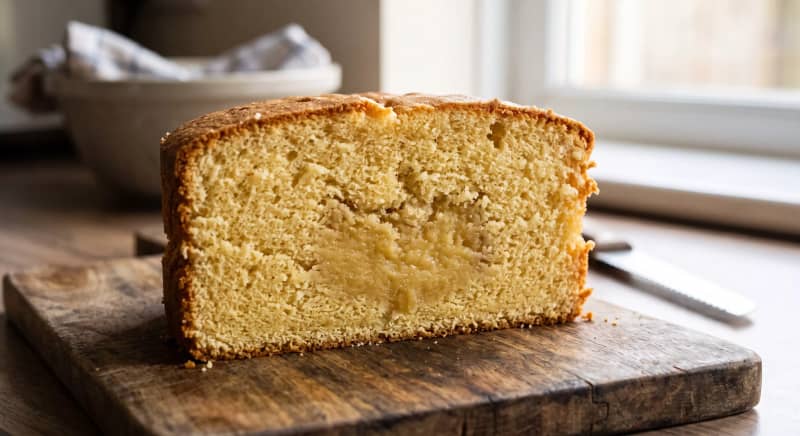
The outside can look browned and finished before enough heat has reached the middle. If the centre is still unset, it may not have enough structure to hold itself up as the cake starts to cool.
Signs include:
- a wet or gummy centre
- raw-looking batter when the cake is cut
- a skewer coming out with wet batter rather than a few cooked crumbs
- the centre dropping noticeably soon after the cake leaves the oven
Do not rely on baking time alone. Ovens and tins vary, so start checking around the point recommended by the recipe and look for the doneness signs appropriate to that particular cake.
Avoid repeatedly opening the oven simply to check progress, especially early in the bake.
2. The Oven Temperature Was Incorrect
An oven that is running too hot can make the outside of a cake colour and set before the middle has baked sufficiently.
It can also encourage a rapid initial rise. If the centre is still weak when that expansion slows, the cake may fall.
An oven that is too cool creates a different problem. The cake may take much longer to set and may not develop the rise or structure expected by the recipe.
Domestic ovens are not always perfectly accurate, so recurring problems across several recipes may be a reason to check how your oven actually behaves.
If your recipe gives a different setting for fan and conventional ovens, make sure you're using the correct one.
3. The Oven Door Was Opened Too Early
Opening the oven door causes the oven temperature to drop.
That is not usually a problem once a sturdy cake is nearly baked, but it can matter earlier when the centre is still expanding and has not yet set.
Light sponges and other delicate cakes can be particularly sensitive at this stage.
Where possible, use the oven light and window to watch the cake during the early part of the bake. Save skewer tests and other hands-on checks until closer to the expected finishing time.
4. Too Much Baking Powder or Bicarbonate of Soda Was Used
More raising agent does not automatically mean a higher or lighter cake.
If too much baking powder or bicarbonate of soda is added, the batter can produce gas faster or in a greater quantity than the developing cake structure can support.
The result may be a cake that rises impressively at first but then sinks.
Too much raising agent can also affect flavour and browning.
Measure small quantities carefully with proper measuring spoons and avoid adding extra because you want more rise.
Baking powder and bicarbonate of soda are also not interchangeable on a simple 1:1 basis.
5. The Mixing or Aeration Method Went Wrong
Mixing problems can affect a cake, but the exact issue depends on the type of recipe.
A traditional creamed cake may depend on properly beating butter and sugar to incorporate air. A whisked sponge relies heavily on the air held in beaten eggs. Another recipe may require flour to be folded in gently so that the existing aeration is not lost.
Once flour is added to many conventional cake batters, excessive mixing can also develop more gluten than intended and give a tougher or denser crumb.
So it is too simple to say that every sunken cake was merely “overmixed”.
Problems can come from:
- not creaming butter and sugar as required
- knocking too much air out of a whisked mixture
- mixing excessively after adding flour
- leaving pockets of unmixed ingredients
- using a different mixing method from the one the recipe specifies
Follow the method as well as the ingredient list. Different cake techniques are written differently because the mixing stages perform different jobs.
6. The Tin Was the Wrong Size or Shape
Cake tin dimensions affect how deep the batter sits and how quickly heat reaches the centre.
If the same quantity of batter is put into a significantly smaller or deeper tin, the layer of mixture becomes deeper. The outside may be well baked while the centre is still underdone.
A much larger tin spreads the mixture more thinly, which changes the baking time and finished shape in the opposite direction.
Depth matters as well as width. Two tins that look broadly similar can hold different volumes, and changing from round to square or rectangular tins introduces another difference in capacity.
If you need to change the tin specified by the recipe, compare the capacities rather than guessing from one measurement alone. Use our cake tin conversion calculator to easily compare sizes.
7. The Ingredient Balance Was Changed
Cake recipes depend on a balance between ingredients that provide structure, moisture, sweetness, fat and lift.
Changing that balance can make a cake less stable.
Possible problems include:
- adding too much liquid
- adding too much sugar
- using too much raising agent
- accidentally reducing the flour
- using the wrong number or size of eggs
- doubling one ingredient by mistake
- replacing an ingredient with one that has a different moisture or fat content
- changing several ingredients at once
This does not mean substitutions always cause cakes to sink. Plenty of substitutions work when a recipe has been designed or properly adjusted for them.
The problem comes when changes alter the balance enough that the cake no longer sets as expected.
When troubleshooting a failed cake, returning to the original recipe and changing only one variable at a time makes it much easier to identify what went wrong.
Quick Cake-Sinking Troubleshooting Table
| What You Notice | Possible Cause | What to Try Next Time |
|---|---|---|
| Wet or gummy centre | Cake not baked through | Bake until the centre is properly set |
| Cake rises very high and then collapses | Excess raising agent or excessive oven heat | Measure raising agents accurately and check oven temperature |
| Cake drops after an early oven check | Structure may not have set before the temperature dropped | Avoid opening the oven too early |
| Dark outside but underdone centre | Oven too hot, batter too deep or tin unsuitable | Check oven temperature and use the specified tin size |
| Dense, uneven or poorly structured centre | Mixing, aeration or ingredient-balance problem | Follow the stated mixing method and measure ingredients accurately |
| Repeated sinking despite following the method | Oven accuracy, tin dimensions or recipe balance | Check one variable at a time |
Can You Fix a Cake That Has Already Sunk?
If the cake is completely baked through and the only problem is a dip in the centre, the sinking may be mainly cosmetic.
Depending on the cake, you could:
- level an uneven top before decorating
- fill a shallow dip with buttercream
- add fruit, cream or another suitable topping
- cut the cake into pieces for a layered dessert or trifle-style pudding
A visibly wet or raw centre is different.
Do not hide an undercooked centre with icing and serve it. Flour-based cake batter needs to be properly cooked.
If you've only just removed the cake from the oven and discover that the centre is still underbaked, returning it promptly to the oven may allow it to finish baking, although the texture or appearance may no longer be ideal.
If it cannot be baked through properly, do not serve the raw portion.
How to Stop a Cake Sinking in the Middle
For more consistent cakes:
- measure ingredients accurately
- use the correct raising agent and quantity
- preheat the oven properly
- make sure the temperature matches your oven type
- use the tin dimensions specified by the recipe
- avoid opening the oven unnecessarily early
- follow the recipe's mixing and aeration method
- avoid changing several ingredients at once
- bake until the centre is properly set rather than relying only on the timer
If sinking happens repeatedly, keep notes on the recipe, tin, oven setting and baking time. A pattern is much easier to diagnose than a single failed cake.
Frequently Asked Questions
Why did my cake sink after I took it out of the oven?
Underbaking is one possibility. If the centre has not set sufficiently, it may collapse as the cake cools. Too much raising agent, an unsuitable oven temperature or changes to the recipe can produce a similar-looking problem, so check the crumb and other clues before deciding on the cause.
Can too much baking powder make a cake sink?
Yes. Too much raising agent can make the batter expand faster or further than its developing structure can support, which may lead to a high rise followed by collapse.
Why is my cake cooked outside but raw in the middle?
The oven may be too hot, the batter may be too deep for the tin, or the cake may simply need longer to bake. Check the recipe's tin size and oven setting as well as the stated baking time.
Can opening the oven door make a cake sink?
It can contribute if the door is opened while the cake is still in a delicate stage and its centre has not yet set. Opening the oven nearer the end of the bake is generally less disruptive.
Can the wrong cake tin size make a cake collapse?
Yes. A smaller or deeper tin can create a thicker layer of batter that takes longer to cook through, while changing to a much larger tin alters the baking conditions in the opposite direction.
The Bottom Line
A cake sinking in middle is usually a clue rather than a diagnosis on its own.
Start with the condition of the centre. If it is wet or gummy, investigate underbaking and oven temperature first. If the cake shot upwards before collapsing, check the raising agents and heat. If the texture is dense or uneven, look more closely at the mixing method and ingredient measurements.
Tin size and recipe substitutions matter too.
Instead of changing several things on the next attempt, identify the most likely cause and adjust one variable. That gives you a much better chance of understanding what actually fixed the problem.
Useful Tools for this Guide
- Use Tool: Cake Tin Conversion Calculator
Cake Tin Conversion Calculator
Resize cake recipes for different round, square, loaf and rectangular tins in cm or inches.