
Ingredient Guides
Caster Sugar vs Icing Sugar: What's the Difference?
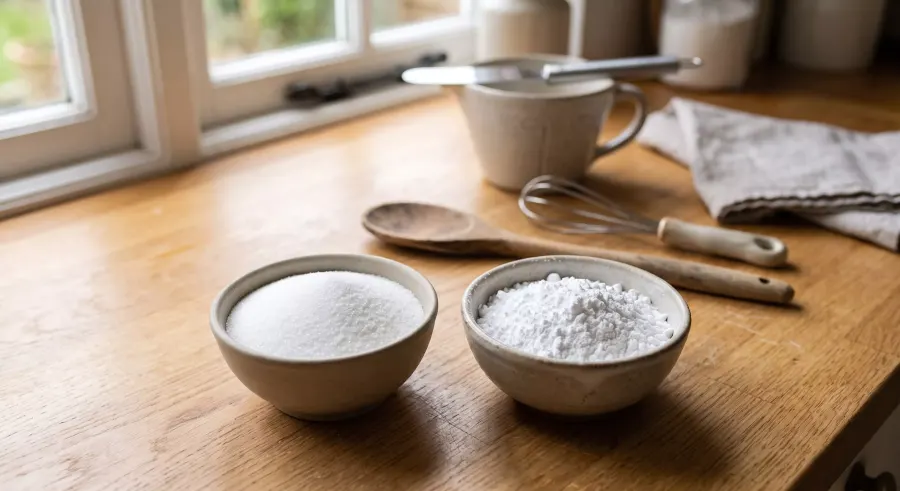
Caster sugar and icing sugar are both forms of sugar, but they are not the same product and they behave differently in baking.
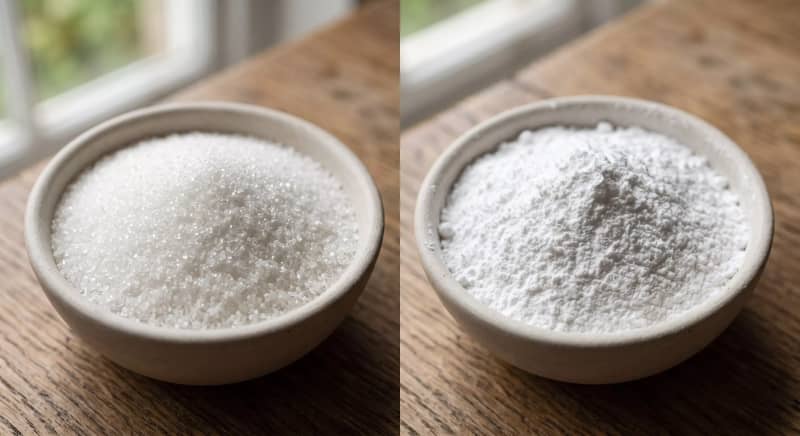
Caster sugar is made up of fine, visible crystals, while icing sugar has been ground into a soft powder. That difference affects how the sugars mix, how quickly they dissolve in water-based mixtures and where they work best in a recipe.
For most British baking, caster sugar is commonly used in cake batters, biscuits and meringues, while icing sugar is the familiar choice for buttercream, glacé icing and dusting.
Is Caster Sugar the Same as Icing Sugar?
No. Although both are primarily sugar, their particle size and texture are very different.
Caster sugar has small crystals — finer than standard granulated sugar, but still clearly crystalline. Icing sugar is ground much more finely until it becomes a powder. Commercial icing sugar may also contain a small amount of anti-caking ingredient to help keep it free-flowing.
Those differences affect how each sugar behaves in a recipe. Caster sugar is useful in methods such as creaming butter and sugar, where the crystals can help with aeration while mixing. Its fine size also helps it dissolve readily in many cake and meringue mixtures.
Icing sugar behaves differently because its particles are much finer. It disperses smoothly into buttercream and dissolves quickly when mixed with liquids, which makes it especially useful for icings and finishes.
Quick answer: Caster sugar is a fine crystalline sugar widely used in British baking. Icing sugar is a powdered sugar used mainly for icing, buttercream, fillings and finishing.
What Is Caster Sugar?
Caster sugar is white sugar with crystals finer than standard granulated sugar but much coarser than icing sugar.
Because the crystals are small, caster sugar dissolves relatively quickly and works well in recipes where the sugar needs to incorporate evenly during mixing.
It is commonly used in British recipes for:
- sponge cakes
- meringues
- biscuits
- whipped egg mixtures
- mousses
- some puddings and desserts
Caster sugar is not essential to every recipe in those categories. The best sugar depends on how the recipe has been formulated and the texture the baker is trying to achieve.
What Is Icing Sugar?
Icing sugar is sugar ground into a very fine powder.
Commercial products may contain a small amount of an anti-caking ingredient, such as starch or another permitted anti-caking agent, to help prevent clumping during storage. The exact formulation varies between brands.
Its powdery texture makes it particularly useful where a smooth finish is important. In mixtures containing liquid, it dissolves very quickly, while in buttercream its tiny particles disperse finely through the fat and help produce a smooth texture.
Typical uses include:
- buttercream
- glacé icing
- frostings and fillings
- dusting cakes and desserts
- some confectionery recipes
Caster Sugar vs Icing Sugar — Main Differences
| Feature | Caster Sugar | Icing Sugar |
|---|---|---|
| Texture | Fine, visible crystals | Soft, fine powder |
| Particle size | Smaller crystals than granulated sugar | Ground much finer than caster sugar |
| Common baking uses | Cakes, meringues, biscuits and whipped mixtures | Icings, buttercream, fillings and dusting |
| Behaviour with liquid | Dissolves relatively quickly | Dissolves very quickly |
| Use in cake batter | Common in many UK cake recipes | Used only where the recipe is specifically formulated for it |
| Use in icing | Not normally the first choice | Standard choice for many smooth icings |
| Direct substitution | Not usually recommended | Not usually recommended |
Can I Use Icing Sugar Instead of Caster Sugar?
Not as a general 1:1 substitution.
In many cake and biscuit recipes, caster sugar is part of the mixing method as well as a source of sweetness. When butter and caster sugar are creamed together, the sugar crystals help create tiny pockets of air in the fat.
Icing sugar has a much finer particle size and therefore behaves differently during mixing. Commercial varieties may also contain a small quantity of anti-caking ingredient.
That does not mean icing sugar can never be used in cake or biscuit mixtures. Some recipes are deliberately formulated with icing sugar and work exactly as intended. The important point is not to assume that it will behave identically to caster sugar in a recipe designed for caster sugar.
If a recipe specifically calls for caster sugar, using the stated sugar is the most predictable approach.
Can I Use Caster Sugar Instead of Icing Sugar?
Usually not when a smooth icing or finish depends on powdered sugar.
Caster sugar retains visible crystals. In buttercream or a simple glacé icing, those crystals may leave the mixture noticeably grainier instead of producing the smooth result expected from icing sugar.
It is also unsuitable as a like-for-like replacement when icing sugar is being used to dust a finished cake or dessert.
A recipe specifically designed around dissolved caster sugar may be different, but simply exchanging equal quantities of caster sugar for icing sugar is not a reliable general substitution.
Which Sugar Is Better for Cakes?
For many traditional UK cake batters, caster sugar is the more common choice.
Its fine crystals incorporate readily during mixing and are particularly useful in recipes that cream sugar with butter or whisk sugar with eggs.
Icing sugar is more commonly used after the cake has baked — for buttercream, icing, fillings or decoration.
There are exceptions. Some cake and biscuit recipes are deliberately made with icing sugar, while others use granulated, brown or other sugars. Follow the sugar specified in a tested recipe rather than assuming one type is always best for every cake.
Which Sugar Is Best for Buttercream and Icing?
In actual fact icing sugar is usually the sensible choice for British buttercream, glacé icing and similar smooth topping.
Its very fine grains dissolve quickly in softened butter and blend easily with liquid to prevent granulation that commonplace caster sugar can still leave behind.
If your icing sugar has clumped together while sitting on the shelf since you last used it, sieve before mixing to help with creating a smooth finish.
Can You Make Icing Sugar from Caster Sugar?
Yes, you can create a functional substitute at home by grinding caster sugar even finer in an appropriate blender, food processor or coffee grinder (or spice grinder).
Short burst process it until powdery and not crystalline.
Wait until the fine powdered sugar dust is settled, remove the lid and sieve if there are larger pieces.
While your homemade icing sugar will not as pure and consistent (or perhaps fine) as a commercial product, it is unlikely to naturally contain the anti-caking ingredients that are found in certain packaged icings. This can be a viable alternative in everyday use, but the precision of texture depends on your equipment.
Caster Sugar, Icing Sugar and Granulated Sugar
The easiest way to distinguish the three is by particle size:
- Granulated sugar has the largest crystals of the three.
- Caster sugar has finer crystals and dissolves more readily.
- Icing sugar is ground into a fine powder and may contain a small amount of anti-caking ingredient.
All three have useful roles in baking, but their different textures mean they should not automatically be treated as interchangeable. For a closer look at those two crystalline sugars, see our guide to caster sugar vs granulated sugar in baking.
Frequently Asked Questions
With that in mind, Let's discuss whether caster sugar and icing sugar are the same?
No, caster sugar comes in little else but the crystals while icing is ground into a powder. Because of their different particle sizes, they also perform differently in baking and icing.
Is icing sugar fine enough to be beaten into butter?
Not in a simple direct replacement kind of way. The reason icing sugar acts differently during mixing is that it may contain an anti-caking ingredient. Use it only when the recipe or a tested substitute allows you to forgo caster sugar.
Can I use caster sugar instead of icing?
Generally not for buttercream, glacé icing or dusting Caster sugar has crystals larger than icing sugar, which can create a grainy look to some products.
Help: Which sugar to use for cakes?
Caster (superfine) sugar: Found in plenty of British cake batters, the fine crystals dissolve and work well for various creaming and whisking methods. Icing sugar is mainly used as filling, frosting or decoration of the cake (there are also some recipes specifically designed to use icing in batter).
What is powdered sugar Icing Sugar What does it mean?
In the US and Canada, powdered sugar is more commonly used than icing sugar in the UK. In fact, they both refer to very finely powdered sugar although different anti-caking ingredients might be used in products from various places.
The Bottom Line
Caster sugar and icing sugar differ primarily in particle size.
Caster sugar still has fine crystals, so it is good for a lot of cakes, meringues and biscuits. It differs from normal sugar in that icing sugar is ground into powder so it can be better used for smoother buttercream, icings and fillings when dusting.
In baking, identical starting material will not always yield the same results. If a recipe calls for one of them, then using that sugar will provide the most reliable texture and finish.