
Ingredient Guides
Baking Powder vs Bicarbonate of Soda: What's the Difference?
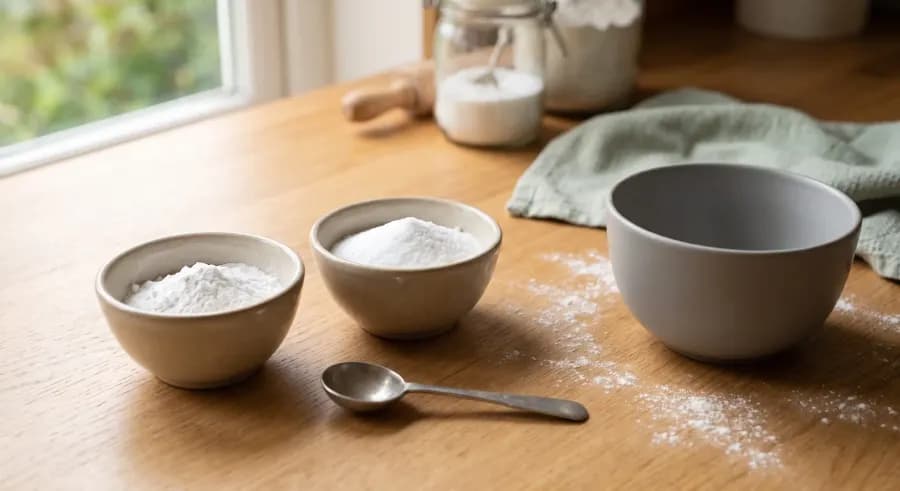
Baking powder and bicarbonate of soda are both raising agents, but they are not the same ingredient and they behave differently in a recipe.
Bicarbonate of soda is the UK name for the ingredient American recipes usually call baking soda. Baking powder is a separate product that contains sodium bicarbonate together with acidic components and, usually, a starch.
Using the wrong one can change the rise, texture, browning and flavour of a bake, so it is worth understanding what each raising agent is designed to do.
Baking Powder vs Bicarbonate of Soda: Quick Answer
Bicarbonate of soda is sodium bicarbonate. It is alkaline and is normally used where the recipe provides enough acidity to create the intended reaction and balance.
Baking powder contains sodium bicarbonate together with one or more acidic ingredients. Because both sides of the reaction are already included, it does not rely on a separate acidic ingredient in the recipe in the same way.
Quick difference: Bicarbonate of soda is normally paired with acidity elsewhere in the recipe. Baking powder already contains both alkaline and acidic components.
What Is Bicarbonate of Soda?
Bicarbonate of soda is sodium bicarbonate. In UK kitchens it is usually called bicarbonate of soda, often shortened to "bicarb". In American recipes, the same ingredient is called baking soda.
That means there is no conversion involved when following a US recipe: if it asks for baking soda, bicarbonate of soda is the UK equivalent.
Because bicarbonate of soda is alkaline, recipes commonly pair it with acidic ingredients such as:
- buttermilk
- yoghurt
- lemon juice
- vinegar
- cream of tartar
- natural, non-alkalised cocoa powder in recipes where its acidity is part of the formulation
Other ingredients, including some syrups and molasses, can also contribute acidity, but the amount varies.
The important point is that you should not decide whether a recipe needs bicarbonate of soda simply by spotting one acidic ingredient. The amount has to be balanced with the rest of the recipe.

What Is Baking Powder?
Baking powder is a prepared chemical raising agent. It contains sodium bicarbonate plus one or more acidic components, usually with a starch added to help keep the mixture dry and stable.
Once the powder is moistened, its ingredients can react and release carbon dioxide. Depending on the formulation, some baking powders also produce further gas as the mixture heats in the oven.
Because the acid is already included in the powder, a recipe can use baking powder for lift without depending on another ingredient to provide the necessary acidity.
Baking Powder vs Bicarbonate of Soda — Key Differences
| Feature | Bicarbonate of Soda | Baking Powder |
|---|---|---|
| What it contains | Sodium bicarbonate | Sodium bicarbonate plus one or more acidic components, usually with a starch |
| Relies on acidity elsewhere in the recipe? | Usually | No — the acidic components are already included |
| Typical role | Reacts within a suitably balanced recipe and also affects browning and flavour | Provides a balanced chemical raising system |
| Flavour risk if overused | Can leave a soapy, bitter or alkaline taste | Can leave an unpleasant bitter or chemical taste |
| Common UK name | Bicarbonate of soda / bicarb | Baking powder |
| US terminology | Baking soda | Baking powder |
| Can they be swapped 1:1? | No | No |
When Should You Use Bicarbonate of Soda?
The familiar example is bicarbonate of soda: it crops up in lots of recipes, where acidity needs to be countered as part of the recipe's balance. These include soda bread, some types of gingerbread, bakes using buttermilk or yoghurt and a few chocolate cakes.
It does more than just produce gas, though. As such, bicarbonate of soda also effects browning, flavour and texture by changing the pH of a mixture.
This does not make it an ingredient that you can throw in every time you want more lift. A correct recipe states the exact amount of bicarbonate you need, and an excess will ruin the result instead of making it better.
When Should You Use Baking Powder?
Baking powder is typically used in products where the recipe requires chemical lifting without acidity from another component of the recipe.
It is found in a lot of cakes, scones, muffins, pancakes and biscuits particularly recipes that use plain flour not self raising flour.
There are plenty of exceptions. Some recipes call for self raising flour; others for bicarbonate of soda and some intentionally use a twosome of raising agents. The entire formulation of the recipe is more important than just the type of bake.
Why Do Some Recipes Use Both?
It is quite normal to see baking powder and bicarbonate of soda in the same ingredient list.
This means there is plenty of acid in the recipe to make bicarbonate of soda useful for balancing acidity, flavour or browning in addition to needing more raising power from baking powder. Having both allows the recipe developer maximum control over rise, texture and ultimately taste.
If you follow a tested recipe that calls for both raising agents, then use both as formulated, rather than assuming one must be superfluous.
Can You Substitute Baking Powder for Bicarbonate of Soda?
Not as a simple 1:1 substitution.
Baking powder is a mixture containing sodium bicarbonate along with acidic ingredients and other components. An equal spoonful therefore does not provide the same chemical balance as an equal spoonful of bicarbonate of soda.
Changing one for the other can alter:
- how much the bake rises
- the acidity and alkalinity of the mixture
- browning
- texture
- flavour
If you have run out of bicarbonate of soda, using a recipe already formulated for baking powder is generally more predictable than changing the raising-agent balance yourself.
Can You Use Bicarbonate of Soda Instead of Baking Powder?
Not simply swapping it again.
On the other hand, bicarbonate of soda does not have the acid components as baking powder. Without sufficient appropriate acid from the recipe, the bicarbonate may result in a too-alkaline batter or dough and produce an off flavour or an undesired texture in the baked product.
But it is not the reliable alternative method to add extra bicarbonate to compensate for the omission of baking powder. If you are not purposely changing the recipe, then use the raising agent it states.
What Happens If You Use the Wrong Raising Agent?
The result depends on the particular recipe and how much the raising-agent balance has changed, but possible problems include:
- poor or uneven rise
- excessive spreading, particularly in biscuits
- a dense or coarse texture
- unexpected browning
- an unpleasant bitter, chemical or soapy flavour
- in some recipes, a rapid rise followed by sinking
Using the wrong raising agent does not produce exactly the same failure in every bake. The surrounding ingredients, acidity and quantities all affect the outcome.
How to Measure Raising Agents Accurately
Raising agents are normally used in small quantities, so an unnecessarily heaped spoon can alter the balance of a recipe.
For consistent results:
- use standard measuring spoons rather than ordinary teaspoons from the cutlery drawer
- level the spoon unless the recipe specifically asks for a heaped measurement
- measure the quantity stated rather than adding extra for a better rise
- check carefully whether the ingredient list says baking powder or bicarbonate of soda before measuring
Baking powder can also become less effective during storage, particularly once moisture has reached it. Keep it tightly closed in a cool, dry place and pay attention to the manufacturer's storage guidance and best-before information if your bakes are no longer rising as expected.
If you're working from an American recipe and want to check the terminology, our guide on baking soda and bicarbonate of soda being the same ingredient explains the UK and US naming difference in more detail.
Frequently Asked Questions
Is baking powder actually bicarbonate of soda?
No. Bicarbonate of soda is sodium bicarbonate while baking powder is a mixture of sodium bicarbonate, an acid (ingredient), and starch. As a note, these are different raising agents and not directly interchangeable.
And in the UK, baking soda = bicarbonate of soda.
Yes. What is baking soda and what is it called in the US?In America, we call bicarbonate of soda "baking soda".
Substituting baking powder for bicarbonate of soda
Not as a direct 1 to 1 replacement. Baking powder has other ingredients and produces a different acid-base reaction in the recipe, so the result may not be as intended.
Substitutes for Baking PowderBaking soda (Bicarbonate of Soda)
Not without taking into account the rest of the recipe. Bicarb is only useful where there is sufficient appropriate acidity to balance it, while baking powder has its acid components proportioned.
Why Do Some Recipes Use Baking Powder AND Bicarbonate of Soda?
It is a balance of rise, acidity, browning, flavour and texture that can be made with both. Use both the quantities given, if a tested recipe states both.