
Cooking Tips
Air Fryer Cooking Times UK: Chicken, Chips, Fish & More
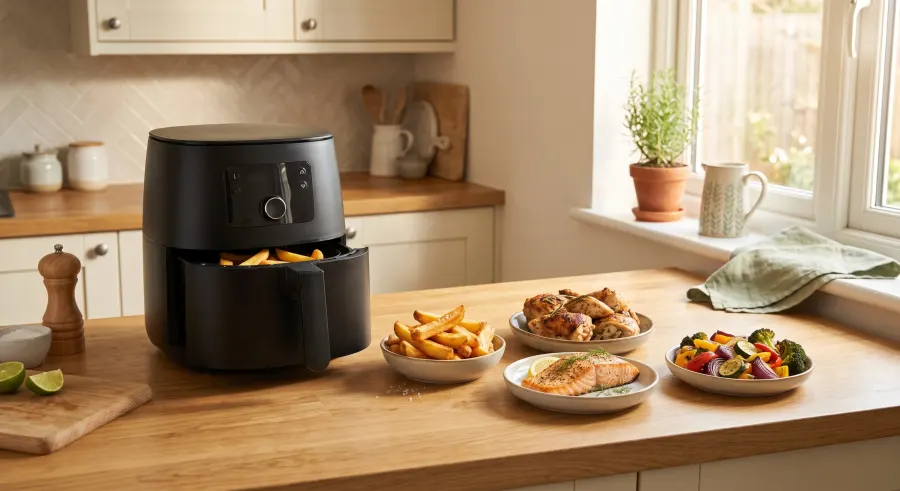
Air fryers often cook food more quickly than a conventional oven, but there is no single cooking-time rule that works for every appliance or ingredient.
Basket size, food quantity, thickness, starting temperature and the individual air fryer all affect the result. The air fryer cooking times below are therefore practical starting ranges rather than guarantees.
For packaged or frozen food, check the packet first and follow any specific air-fryer instructions provided by the manufacturer. For poultry, pork, burgers, sausages and other foods that need thorough cooking, do not rely on the timer or surface colour alone.
Quick rule: Use the chart as a starting point. Check food before the end of the suggested range, turn or shake where useful, and make sure foods that require thorough cooking are safely cooked through before serving.
Air Fryer Cooking Times Chart
This air fryer time and temperature chart gives approximate starting points for common foods in UK kitchens.
| Food | Air Fryer Temperature | Approx. Cooking Time | Useful Tip |
|---|---|---|---|
| Frozen chips | 200°C | 12–18 minutes | Check packet instructions first; shake halfway |
| Homemade chips | 190–200°C | 20–30 minutes | Cook in a loose layer and shake several times |
| Chicken breast, boneless | 190–200°C | 15–22 minutes | Thickness matters; check the thickest part is fully cooked |
| Chicken thighs, bone-in | 180–190°C | 20–25 minutes | Turn halfway and check beside, not against, the bone |
| Chicken drumsticks | 180–190°C | 20–30 minutes | Turn during cooking; larger drumsticks may need longer |
| Chicken Kiev, frozen | 180–190°C | 18–25 minutes | Follow the packet where instructions are provided |
| Fish fingers, frozen | 200°C | 8–12 minutes | Follow packet guidance and turn halfway |
| Salmon fillet | 190–200°C | 8–12 minutes | Thickness matters; check before the upper end of the range |
| Sausages | 180°C | 10–15 minutes | Turn during cooking and make sure the centre is thoroughly cooked |
| Bacon | 200°C | 4–10 minutes | Back bacon is usually quicker than thick streaky bacon |
| Beef burgers | 180–200°C | 10–14 minutes | Turn halfway and cook thoroughly through the centre |
| Gammon steak | Around 180°C | 8–12 minutes | Treat as raw unless the packet clearly states otherwise; follow pack guidance |
| Lamb chops | 190–200°C | 7–10 minutes | Time depends heavily on thickness and preferred doneness |
| Broccoli / cauliflower | 180–190°C | 8–12 minutes | Cut evenly and shake halfway |
| Baked potato | 190–200°C | 40–50 minutes | Large potatoes can take longer; turn partway through |
These ranges assume reasonably typical portions. A very thick chicken breast, oversized baked potato or heavily loaded basket may need longer.
Chicken Air Fryer Times
Chicken needs to be thoroughly cooked before serving, so use time as a guide rather than the final test.
Chicken Breast
A boneless chicken breast will often take around 15–22 minutes at 190–200°C, but thickness matters more than weight alone.
A small or butterflied breast can cook considerably faster than a thick whole fillet.
Turn the chicken during cooking if that suits your air fryer, then check the thickest part. With a thermometer, measure away from bone or the basket surface.
Without a thermometer, cut into the thickest part and check that the chicken is steaming hot, there is no pink flesh and the juices run clear.
Chicken Thighs
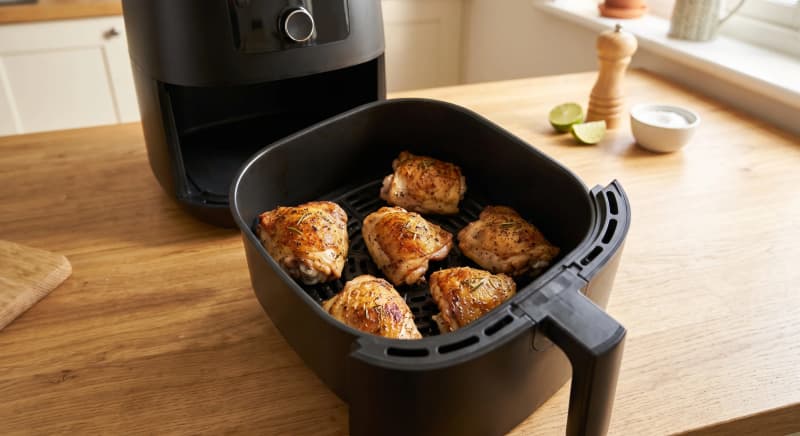
Bone-in chicken thighs commonly need around 20–25 minutes at 180–190°C.
Boneless thighs can cook faster, so begin checking earlier rather than automatically giving every thigh the same time.
Turn them during cooking if needed for more even browning.
Chicken Legs or Drumsticks
Chicken drumsticks vary considerably in size. Around 20–30 minutes at 180–190°C is a useful starting range.
Arrange them with space around each piece rather than packing the basket tightly, and turn them during cooking.
Check the thickest part is fully cooked before serving.
Chicken Kiev
Frozen chicken Kiev is one food where the packet matters more than a general chart.
Different products vary in size, coating and whether the chicken is raw or has had any previous cooking step. Use the manufacturer's air-fryer instructions where available.
Do not assume the Kiev is ready simply because the garlic butter inside is bubbling. Check that the chicken itself is thoroughly cooked.
Chips and Potato Air Fryer Times
The thickness of the potato has a large effect on chips air fryer time.
Thin frozen fries may cook in little more than 12 minutes, while chunky homemade chips or wedges can take considerably longer.
For homemade chips:
- cut them to a reasonably even size
- avoid packing the basket too tightly
- shake or turn them during cooking
- check them before the end of the suggested range
- add a little extra time if the centres are not yet tender
Parboiling is useful for some styles of homemade chips but is not essential to every air-fryer chip recipe.
Baked potatoes take much longer. Around 40–50 minutes at 190–200°C is a useful starting point for medium-to-large potatoes, but very large potatoes can take longer.
Fish and Fish Finger Air Fryer Times
Frozen fish fingers generally cook quickly in an air fryer.
Around 8–12 minutes at 200°C is a useful starting range, but packet instructions should take priority where the manufacturer gives specific air-fryer guidance.
Arrange them without heavy overlapping and turn them partway through if necessary.
Fresh fish fillets vary mainly with thickness.
A salmon fillet may take roughly 8–12 minutes at 190–200°C. Begin checking a thinner fillet earlier.
Cooked fish should become opaque rather than translucent and separate easily with a fork.
Sausages, Bacon and Burgers
Sausages
Many sausages cook in around 10–15 minutes at 180°C.
Thick sausages may need longer than thin chipolatas, so do not rely on one exact time for every type.
Turn them during cooking and check they are thoroughly cooked in the centre.
Bacon
Bacon is particularly variable.
At around 200°C, back bacon may be ready in roughly 4–8 minutes, while thicker or streaky rashers may take around 6–10 minutes depending on how crisp you want them.
Cook in a single layer where possible and start checking early.
Burgers
Beef burgers generally need around 10–14 minutes at 180–200°C depending on their thickness and whether they started chilled or frozen.
Turn them during cooking.
A browned outside is not enough to show that a burger is safe in the centre. Minced-meat burgers should be cooked thoroughly rather than served pink at home.
Vegetables in the Air Fryer
Vegetable air fryer times depend heavily on cut size.
Small broccoli or cauliflower florets may cook in around 8–12 minutes at 180–190°C, while dense root vegetables can take noticeably longer.
For more even cooking:
- cut pieces to a similar size
- use a light coating of oil where appropriate
- leave enough room for air circulation
- shake or turn the vegetables partway through
If you're cooking vegetables with very different densities, adding them at different times can work better than putting everything into the basket together.
Gammon, Lamb and Larger Cuts
Gammon Steak
Gammon is cured pork, but curing does not automatically mean a gammon steak is ready to eat.
Many supermarket gammon steaks are sold as raw meat and need thorough cooking.
Around 8–12 minutes at roughly 180°C can be a useful air-fryer starting range for an individual chilled steak, but product thickness varies and some supermarkets give their own specific air-fryer times.
Always check the packaging.
Unless the label clearly states that the product is ready-cooked, treat a gammon steak as meat that needs cooking thoroughly.
Lamb Chops
Lamb chops are whole cuts rather than minced meat, so the approach is different from burgers or sausages.
Around 7–10 minutes at 190–200°C can be a useful starting range for typical chops, but thickness and preferred doneness make a substantial difference.
Turn them during cooking and make sure the outside surface is properly cooked.
If consistent doneness matters, a clean food thermometer is more dependable than judging only by the clock.
Roast Beef / Larger Joints
Roast beef air fryer cooking times are harder to reduce to a simple chart.
Two joints of the same weight can have very different shapes and thicknesses, which changes the time needed for heat to reach the centre.
Cooking time also depends on:
- joint weight
- thickness and shape
- starting temperature
- the air fryer model
- whether you prefer rare, medium or well-done beef
For that reason, avoid relying blindly on a single “minutes per 450g” rule.
Use guidance written for the particular size of joint and your appliance, then use a thermometer if you want a particular degree of doneness.
How to Convert Oven Cooking Times to an Air Fryer
Air fryer cooking times are often shorter than conventional-oven times, but there is no universal conversion that suits every food.
The food's size, moisture level, dish or basket, starting temperature and appliance all affect the result.
If you're adapting an oven recipe, our Air Fryer Calculator can give you a practical starting estimate for time and temperature.
Treat the result as a starting point and begin checking the food before the estimated finishing time.
Should You Preheat an Air Fryer?
It depends on the appliance and the food.
Some air fryer manufacturers recommend preheating for particular programmes or foods, while other models are designed to start cooking from cold.
Follow your air fryer's instructions if they specify what to do.
Preheating can affect the actual cooking time because the food starts in an already-hot cooking chamber. If a recipe was tested using a preheated air fryer and you skip that step, the food may need longer.
When Should You Shake or Turn Food?
Shaking is particularly useful for loose foods such as:
- chips
- potato wedges
- small vegetables
- some frozen foods
It exposes different surfaces to the circulating air and can improve even browning.
Larger pieces such as chicken, burgers and gammon steaks are usually easier to turn with tongs.
Delicate fish may not need turning at all if doing so is likely to break the fillet.
Why Your Air Fryer May Cook Faster or Slower
Two people can follow the same air fryer cooking times and still get slightly different results.
Important variables include:
- air fryer model
- wattage
- basket size and shape
- quantity of food
- overcrowding
- food thickness
- fresh, chilled or frozen starting state
- whether the appliance was preheated
- starting temperature of the food
This is why a sensible air fryer cooking times chart uses ranges rather than pretending every appliance will finish at exactly the same minute.
Air Fryer Safety Tips
For safer air-fryer cooking:
- follow the manufacturer's appliance instructions
- follow packet cooking directions where they are provided
- leave enough room for hot air to circulate
- keep the appliance's air vents unobstructed
- use oven gloves or suitable heat-resistant protection when handling hot baskets
- avoid judging meat safety only by surface browning
- thoroughly cook poultry and pork
- thoroughly cook burgers, sausages and other minced-meat products
- use a clean food thermometer when you need a more reliable check
- clean the thermometer probe between uses to avoid cross-contamination
For foods that need thorough cooking, UK Food Standards Agency guidance gives 70°C for 2 minutes in the centre as a standard safe time-and-temperature combination. Equivalent combinations include 75°C for 30 seconds and 80°C for 6 seconds.
If you do not have a thermometer, use the appropriate visual checks as well. Chicken and pork should be steaming hot throughout, with no pink flesh where thorough cooking is required.
Whole cuts of beef and lamb are different from burgers and sausages because contamination is normally on the outside surface rather than mixed throughout the meat.
Frequently Asked Questions
What temperature should I use in an air fryer?
Not every food has one specific temperature where it will be cooked. Most common air-fryer foods will cook between 180°C and 200 °C but the correct time depends on ingredient, thickness and appliance. This can be by using a chart or recipe as guidance.
How much quicker is an air fryer than an oven?
While it is true that air fryers are generally faster than standard ovens there isn't an accurate set percentage you can use for every recipe. The difference lies in the type of food, equipment and temperature.
How long do chicken thighs take in an air fryer?
Typically, bone-in thighs will need about 20–25 min at 180-190°C whereas boneless thigh may take a little less (~15mins). Ensure the chicken is fully cooked before serving.
In an air fryer – fish fingers will take around 10-15 minutes to cook?
Frozen fish fingers: typically 8–12 minutes at 200°C. Check the packet first as lots of brands have their own air-fryer instructions
Should I Preheat My Air Fryer?
Not always. As for your air fryer, be sure to follow the directions for both this recipe and most appropriately. Some models or foods work better with preheating, others without it.
Can I use oven cooking times in an air fryer?
Not directly. An oven time can provide a starting point, but air fryers often cook differently. Use an air-fryer conversion estimate and begin checking before the predicted finishing time.
The Bottom Line
Air fryer cooking times are helpful guidelines but not hard-and-fast rules.
Look at the chart to select an approximate temperature and time range, then modify it according to how large your food pieces are than what is listed here, where you fill your basket up a lot or only partway with food — plus action of your individual frying appliance.
For packaged food, follow manufacturer instructions if available. Instead of just time or colour, check if the centre is done for chicken, pork and other foods that need to be thoroughly cooked such as burgers, sausages.
These ranges are easier to adjust for the foods you make most once you're familiar with your own air fryer.
Useful Tools for this Guide
- Use Tool: Air Fryer Calculator
Air Fryer Calculator
Convert oven temperatures and cooking times for your air fryer. Optimised for UK home cooks using fan or conventional ovens.