
Baking Guides
How to Tell When a Cake Is Fully Baked
Learn how to tell when a cake is baked using visual signs, gentle touch and skewer testing, without relying on the timer alone.
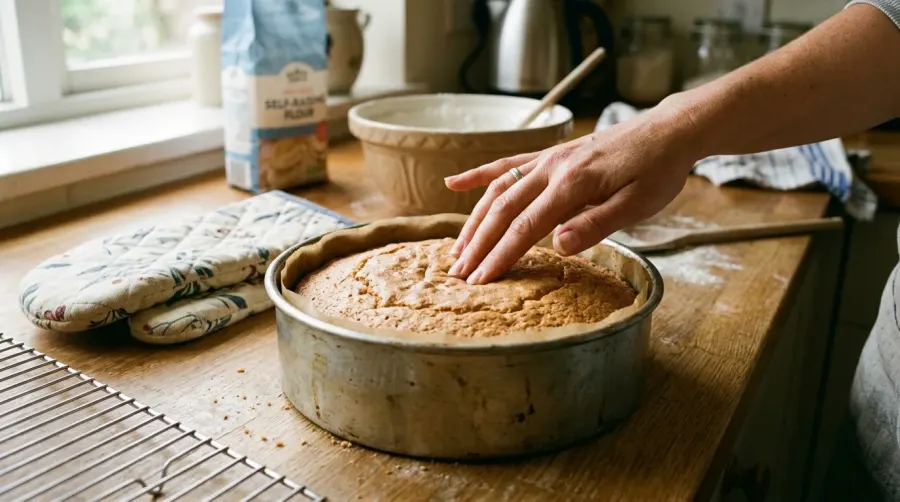
The timer goes off and the cake looks golden on top. That still does not tell you for certain what is happening in the middle.
Recipe times are useful estimates, but ovens vary, tins vary and the depth of the batter changes how quickly heat reaches the centre.
For most cakes, the best approach is to use several clues together. Look at the surface, check the centre, feel the texture where appropriate, then use a skewer if that test suits the cake you are baking.
Look through the oven door before opening it
The first check does not need to involve opening the oven at all.
If your oven has a clear window, look at the centre of the cake.
A cake that still needs time may have:
- a wet or glossy-looking surface
- a centre that has not fully set
- obvious movement in the middle
- an uneven rise that is still changing
As a typical sponge nears the end of baking, the surface usually looks more settled and less shiny.
Opening the door repeatedly during the early stages of baking is not helpful, particularly with lighter sponge cakes whose structure is still developing.
Once the cake is close to the expected baking time, opening the oven briefly to check it is much less of a concern.
Pay attention to the centre, not just the colour
The outside of a cake usually sets before the deepest part of the centre.
That is why a golden top or browned edge cannot tell you everything.
A cake can have plenty of colour while still being underbaked inside, especially if:
- the tin is deep
- the oven is running hot
- the top receives strong heat
- the batter layer is thicker than the recipe intended
Look at the centre.
For a standard sponge, it should appear set rather than wet or glossy.
If the middle is clearly loose or moving much more than the rest of the cake when the tin is handled carefully, it probably needs further baking.
The important word is probably. Cakes such as cheesecakes and deliberately soft bakes are expected to behave differently.
Try the gentle press test for a typical sponge
For many sponge-style cakes, touch can tell you something that colour cannot.
Press the centre very lightly with a fingertip.
A well-set sponge will usually spring back rather than leaving a deep indentation.
If the surface remains noticeably depressed, the structure may still need more time to set.
Keep the pressure light. You are testing the surface, not pushing into the cake.
This method works best with cakes such as:
- Victoria sponge
- plain sponge cakes
- many simple loaf cakes
It is much less useful for brownies, cheesecakes, very sticky cakes or anything deliberately designed to remain soft in the centre.
Treat spring-back as one clue, not a universal test.
The skewer test is useful, but only for the right cake
The skewer test is one of the most familiar ways to check a cake.
Insert a thin skewer or cocktail stick into a central part of a plain sponge, then pull it out.
If it is coated in obvious raw batter, the centre has not finished baking.
If it comes out clean or with a few dry crumbs, that is usually a good sign for an ordinary sponge cake.
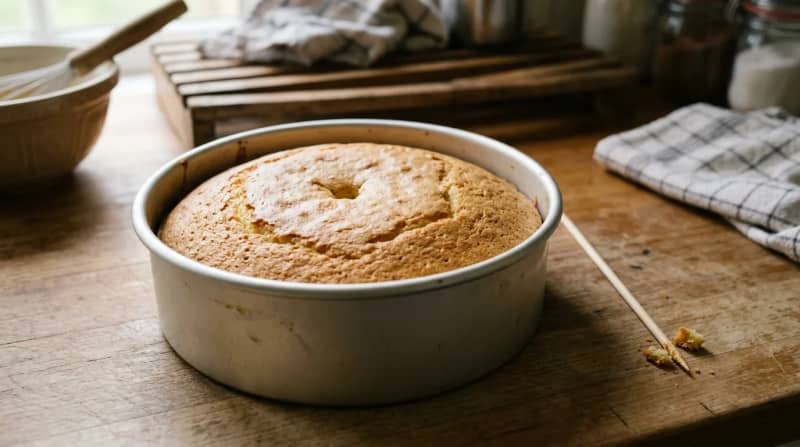
The problem is that not every cake is supposed to produce a dry skewer.
A skewer can also pick up:
- melted chocolate
- soft fruit
- jam or filling
- intentionally moist crumbs
- sticky cake mixture that remains soft when fully baked
A chocolate chip cake, for example, may leave melted chocolate on the skewer even when the sponge around it is cooked.
Brownies are another good example. Waiting for a completely dry skewer can push many brownie recipes past the texture they are meant to have.
Use the test that fits the recipe rather than expecting every cake to behave like a plain sponge.
The edges can give you supporting clues
As many cakes finish baking, the outside becomes firm and may begin to come slightly away from the side of the tin.
A small amount of separation can be normal.
A large gap around the entire cake is different. If the edges have pulled strongly away and the cake also feels very firm or dry, it may have gone further than intended.
Tin colour can influence this too.
Dark metal can encourage stronger browning around the outside, while different materials transfer heat in different ways.
That is another reason not to use the edge of the cake as your only test.
Different cakes need different signs
A useful doneness test depends on what you are making.
| Cake or bake | Useful signs to look for | Do not rely on this alone |
|---|---|---|
| Victoria-style sponge | Set centre, light spring-back, skewer without raw batter | Surface colour |
| Plain loaf cake | Centre feels set, skewer where suitable | Browning on top |
| Fruit cake | Firm structure and recipe-specific skewer test | Perfectly clean skewer |
| Chocolate cake | Set sponge, skewer interpreted around melted chocolate | Dark colour |
| Brownie-style bake | Set edges and the centre texture specified by the recipe | Completely dry skewer |
| Cheesecake | Set outer area with the centre behaving as the recipe describes | Spring-back test |
The recipe still matters.
A cheesecake designed to have a slight movement in the centre should not be judged like a Victoria sponge. A brownie designed to stay fudgy should not be baked until its centre resembles a dry cake crumb.
Signs that a sponge may still be underbaked
With an ordinary sponge cake, several signs together can suggest that the centre needs longer.
These can include:
- raw batter on a skewer
- a glossy or wet-looking centre
- a central area that still feels unstable
- obvious loose movement in the middle
- a surface that does not yet appear properly set
Avoid trying to diagnose the cake from one dramatic-looking moment.
For example, a cake sinking is not automatically proof that it simply needs more oven time. Cakes can sink for several reasons, including problems with structure, raising, mixing or baking. If you are experiencing collapsed bakes, explore our guide on why cakes sink in the middle.
If the cake is clearly underbaked but the top already has plenty of colour, follow the recipe's guidance where available and protect the surface only if the method calls for it.
The aim is to finish setting the centre without guessing at a universal extra baking time.
What does an overbaked cake look like?
The opposite problem has its own clues.
A cake may have baked too far if several of these appear together:
- unusually hard or firm outer crust
- edges pulled well away from the tin
- noticeably dry crumb
- more browning than the recipe normally produces
- a cake that feels firm throughout rather than soft and springy
Colour alone is still not enough.
Chocolate cakes are naturally dark, while some fruit cakes are designed for a long bake and develop deeper colour.
Compare the cake with the texture the recipe is supposed to produce. If your bakes are turning out dry or crumbly, see our troubleshooting advice on Why Is My Cake Dry? Common Causes and Fixes.
Why the recipe time can be different in your kitchen
A recipe might say 30 minutes and your cake might need slightly less or slightly more.
Several things can explain that difference.
Oven setting
A fan oven and a conventional oven move heat differently.
Using the wrong temperature for your oven type can affect how quickly the outside and centre bake. Check our guide on Fan Oven vs Conventional Oven: What's the Difference? to ensure you are setting the right heat for your appliance.
Actual oven temperature
The number on the dial is not always the exact temperature inside the oven.
If several reliable recipes repeatedly cook much faster or slower than expected, the oven itself is worth checking.
Tin size
A larger tin can spread the same amount of batter into a thinner layer, which may bake sooner.
A smaller or deeper tin can leave a thicker centre that takes longer. Follow our guide on how to convert a cake recipe for a different tin size to adjust scaling and baking times accurately.
Tin material
Dark, light, thick and thin tins do not all transfer heat in exactly the same way.
Shelf position
Where the cake sits in the oven can influence how much heat reaches the top and bottom.
These factors explain why a timer is best treated as the point at which you begin judging the cake, not as proof that it is ready.
A simple way to check a typical sponge
When an ordinary sponge is close to its expected baking time, work through three questions.
1. Does the centre look set?
It should not look like wet batter or have obvious loose movement.
2. Does the surface respond normally to a light touch?
For a sponge that suits this test, the centre should usually spring back rather than staying deeply indented.
3. What does the skewer show?
If the recipe suits a skewer test, check for raw batter rather than demanding a perfectly spotless skewer in every situation.
Do not turn this into a strict scoring system.
One strong sign of underbaking, such as obvious raw batter in the centre, matters more than having two weaker signs that appear fine.
Use the clues together and interpret them according to the cake you are actually making.
Let the cake give you more than one clue
The timer tells you when to start paying closer attention.
The cake itself tells you when it is ready.
For an everyday sponge, look first at the centre, then use touch and a skewer where they make sense. For brownies, fruit cakes, cheesecakes and other bakes, adjust the test to suit the texture the recipe is meant to produce.
Learning to recognise those differences is much more useful than trying to find one doneness rule that works for every cake.
Useful Tools for this Guide
- Use Tool: Cake Tin Conversion Calculator
Cake Tin Conversion Calculator
Resize cake recipes for different round, square, loaf and rectangular tins in cm or inches.