
Cooking Tips
Fan Oven vs Conventional Oven: What's the Difference?
Learn the difference between fan and conventional ovens, how to adjust temperatures, and what each setting means for everyday cooking and baking.
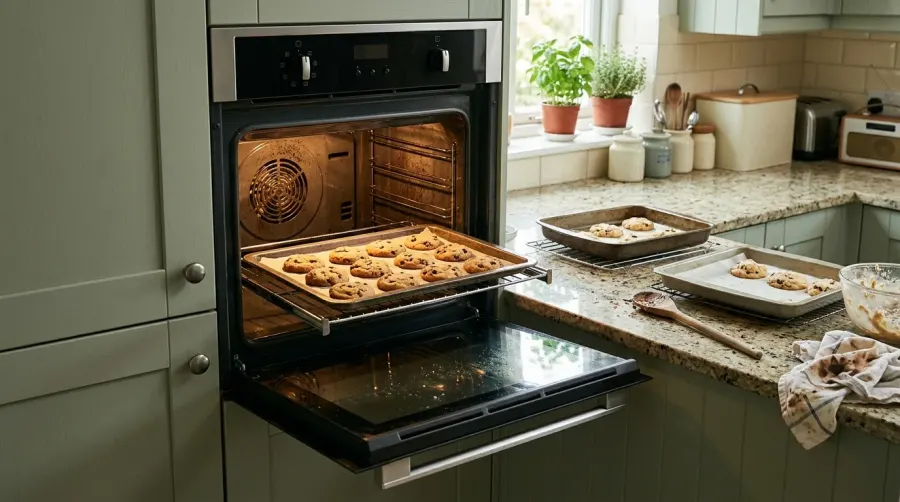
A fan oven and a conventional oven can be set to different temperatures for the same recipe, and there is a simple reason for that.
A conventional setting normally uses heat from the top and bottom of the oven without deliberately circulating the air. A fan setting moves hot air around the cavity, helping heat reach the food more efficiently.
That is why UK recipes often give a lower temperature for a fan oven.
A common example is:
180°C conventional = about 160°C fan
That 20°C difference is a useful starting point, but it is not a rule that fits every oven.
Fan and conventional ovens at a glance
| Feature | Conventional oven | Fan oven |
|---|---|---|
| Heat movement | Mainly natural movement from heating elements | Heated air is circulated |
| Recipe temperature | Usually the higher figure | Often around 20°C lower |
| Browning | Can vary more by shelf position | Often more even |
| Multiple shelves | Results may vary between shelves | Often better suited to several shelves |
| Delicate bakes | Gentler airflow can be useful | Moving air can affect some delicate surfaces |
| Roasting | Works well, especially on one level | Useful for even browning and circulation |
| Best approach | Follow recipe and shelf guidance | Follow the fan temperature given by the recipe |
These are tendencies, not guarantees. Oven design, shelf position, tray type and temperature accuracy can all change the result.
What happens on a conventional setting?
A conventional electric oven normally heats using elements positioned near the top and bottom of the cavity.
There is no fan deliberately pushing that hot air around.
Instead, heat moves naturally through the oven. This can create areas that are slightly hotter or cooler than others.
Shelf position therefore matters.
A dish close to the top may receive stronger heat from above, while something placed low in the oven can get more heat from underneath. Using several shelves at once can also affect how evenly food cooks.
This type of heat can be useful for bakes where gentle, steady heating is more important than strong air circulation.
Some pastries, cakes and other delicate bakes may suit conventional top-and-bottom heat particularly well, especially when the recipe specifically asks for that setting.
A fan oven is not quite the same thing
The words fan oven and fan-assisted oven are sometimes used as though they mean exactly the same thing, but oven designs can differ.
A true fan oven commonly has a heating element positioned around the fan at the rear of the oven.
A fan-assisted setting may use the oven's other heating elements while a fan helps move the heated air around the cavity.
From a home cook's point of view, the important part is that hot air is being circulated rather than relying only on natural heat movement.
That circulation can help food cook more evenly across different parts of the oven.
It can also make using more than one shelf easier because warm air can move around the trays.
Good airflow does not mean every fan oven is perfectly even. A particular oven can still brown more strongly near the back, one side or one shelf.
Why is the fan temperature usually lower?
Moving hot air transfers heat to the surface of food efficiently.
If you used the same high temperature as a conventional setting, the outside of some foods could colour or cook sooner than intended.
For that reason, a roughly 20°C reduction is widely used as a starting point when converting a conventional oven temperature to fan.
For example:
- 200°C conventional becomes about 180°C fan
- 180°C conventional becomes about 160°C fan
- 160°C conventional becomes about 140°C fan
If the recipe already gives a separate fan temperature, use that figure rather than doing another conversion yourself.
Your oven manual should also take priority if the manufacturer recommends a particular adjustment. If you are also converting recipes between UK gas marks, Fahrenheit and Celsius, our comprehensive UK to US Baking & Cooking Conversion Guide provides full oven temperature conversion charts alongside ingredient weights.
Quick conventional to fan oven conversion
| Conventional oven | Approximate fan setting |
|---|---|
| 120°C | 100°C |
| 140°C | 120°C |
| 160°C | 140°C |
| 180°C | 160°C |
| 200°C | 180°C |
| 220°C | 200°C |
Think of this as a quick reference rather than a promise that every oven will behave identically.
An oven that runs hotter or cooler than its dial suggests may still need a small adjustment.
Does a fan oven cook food faster?
Sometimes, but there is no useful universal percentage that works for every recipe.
Fan circulation can make heat transfer more efficient, so food may cook or brown sooner. Lowering the fan temperature is partly intended to compensate for that difference.
Cooking time still depends on much more than the oven label.
A thin tray of biscuits behaves differently from a deep cake. Roast vegetables respond differently from a covered casserole.
Instead of automatically cutting a recipe's cooking time by a fixed percentage, begin with the recommended time and start checking the food when it is approaching the expected finish.
What you look for depends on what you are cooking.
For example:
- a sponge should look set through the centre
- biscuits may begin colouring around their edges
- roast vegetables should be tender as well as browned
- bread should have the colour and structure expected by the recipe
- foods where internal temperature matters for safety should be checked appropriately
The clock is useful, but it is only one part of judging whether food is ready.
Which setting is better for baking?
There is no single setting that is always best for cakes, bread, biscuits and pastry.
For a delicate sponge, calmer conventional heat can sometimes be useful because there is no strong stream of moving air across the surface.
The same can apply to some delicate pastries and meringue-style bakes.
A fan setting has advantages too.
If you are baking several trays of biscuits, for example, circulating air can make it easier to use more than one shelf. Fan heat can also be useful for traybakes and other bakes where even heat around a larger area is helpful.
Bread can work well with either setting depending on the recipe and oven.
The simplest rule is not to choose a setting based only on the type of food. If a tested recipe specifically says 160°C fan, use the fan setting. If it specifies conventional heat, follow that instead. Opening the door too early in a fan oven can cause a sudden temperature drop that destabilises a rising sponge; if this has happened to your bakes, take a look at our troubleshooting guide on why cakes sink in the middle.
Where fan heat is especially useful
For everyday savoury cooking, fan circulation can be particularly handy when you want good browning or need more than one shelf.
Examples include:
- trays of roast vegetables
- oven chips
- several trays cooking at the same time
- dishes where an evenly browned surface is useful
Air needs space to move, though.
Packing several large trays tightly together can restrict circulation and reduce one of the main benefits of the fan.
A covered casserole is different. Because the food is protected by the lid and cooking in a moist environment, strong airflow around the outside of the dish often matters less.
So fan heat is useful, but it is not automatically better for everything placed in an oven. If you often adapt oven recipes for smaller countertop appliances, you can also explore our Air Fryer Cooking Times UK Guide or use our free Air Fryer Calculator to adjust cooking times accurately.
What if the recipe gives only one temperature?
This is where it is better not to guess too confidently.
The recipe says 180°C fan
Use 180°C on the fan setting.
Do not subtract another 20°C. The recipe has already specified the setting.
The recipe says 180°C / 160°C fan
The conversion has already been provided.
Use:
- 180°C on conventional heat
- 160°C on fan
The recipe simply says 180°C
Check the recipe's instructions, notes or source to see whether it explains which oven mode is intended.
Do not assume that a single temperature always means conventional. Modern recipe publishers use different conventions, and some recipes are developed primarily for fan ovens.
If you cannot find any clarification, the instructions for your own appliance can help you choose an appropriate starting point.
Your own oven matters more than people expect
Two ovens set to exactly the same temperature do not necessarily produce exactly the same result.
One may run slightly hot. Another may take longer to recover after the door is opened.
You might also notice that biscuits near the rear of a tray colour sooner than those at the front.
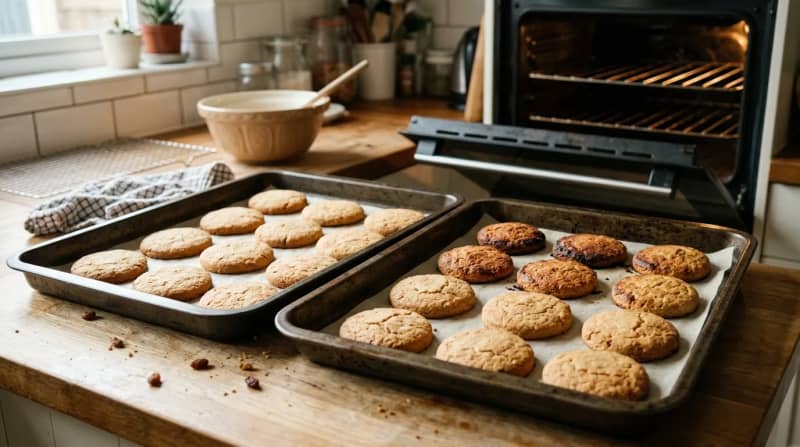
A few everyday details can make a visible difference.
Opening the door repeatedly
Every time the oven door opens, some hot air escapes.
For something quick such as roast vegetables this may not matter much, but repeatedly opening the door during a delicate bake can disturb the cooking environment.
Crowding the shelves
A fan needs room to circulate air.
Large trays positioned very close together can interfere with that circulation.
The baking tray itself
Dark metal trays can absorb heat differently from pale or shiny ones, so the bottoms of biscuits and similar foods may brown at different rates.
Shelf position
Fan circulation reduces some differences between shelves, but it does not make shelf position irrelevant.
Follow the recipe's recommended position when one is given.
How to tell if your oven runs hot or cool
If food repeatedly finishes much sooner than expected, burns around the edges or remains undercooked despite following reliable recipes carefully, the actual oven temperature may be worth checking.
A separate oven thermometer can give you a rough idea of what is happening inside the cavity.
Place it according to its instructions and compare the reading with the oven setting after the oven has had time to stabilise.
One unusual bake does not necessarily mean the oven is inaccurate. Look for a repeated pattern across several dishes before changing the way you use it.
Which setting should you use?
If the recipe gives separate temperatures for conventional and fan ovens, use the one that matches your setting.
If you genuinely need to convert a conventional temperature for a fan oven, reducing it by about 20°C is a sensible UK starting point.
Then pay attention to the food.
Your oven's real temperature, the shelf you use, the type of tray and how crowded the cavity is can all matter more than a perfect-looking number on a conversion chart.