
Baking Guides
How to Convert a Cake Recipe for a Different Tin Size
Learn how to convert a cake recipe for a different tin size using simple area calculations, ingredient scaling and practical baking checks.
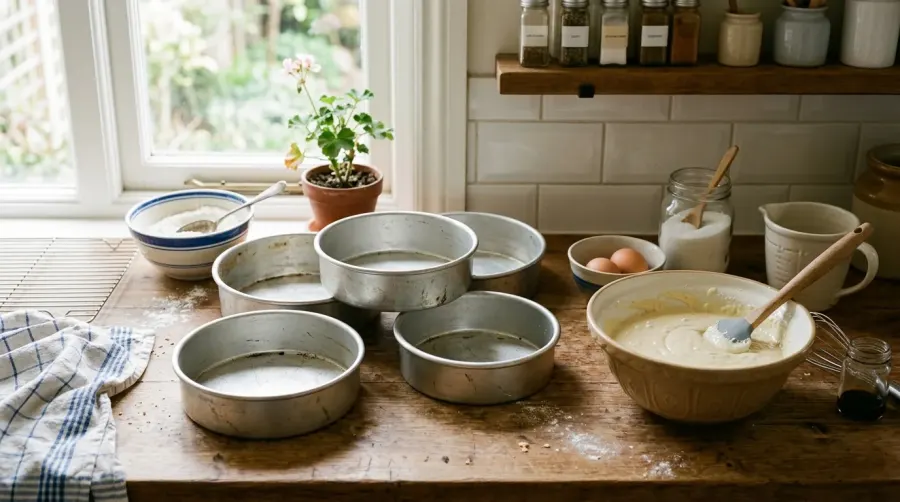
A cake recipe says to use a 20 cm round tin, but the tin in your cupboard is 18 cm or 23 cm. That difference might not look like much, but it changes how deep the batter sits, how much mixture the tin needs and how the cake behaves in the oven.
Put the original amount of batter into a larger tin and the cake may come out thinner than intended. Put it into a much smaller tin and the batter may sit too deep, take longer to bake or rise too close to the rim.
You do not need a complicated conversion chart to make a sensible adjustment. For ordinary cake tins of a similar depth, comparing the area of the two bases gives you a useful starting point.
Start with the area, not just the diameter
A 23 cm tin is not simply a little larger than a 20 cm tin in terms of how much batter spreads across its base.
The important difference is the area inside the tin.
If two tins are roughly the same depth, keeping a similar amount of batter for each square centimetre of base helps preserve something close to the intended cake depth.
Before calculating anything, measure the inside dimensions of the tin where possible. Thick rims and handles can make the outside measurement misleading.
This method works particularly well for ordinary round, square and rectangular cake tins. It is still an estimate. Very deep tins, loaf tins and unusually shaped tins need a little more thought because capacity and shape also affect the bake.
How to calculate the base of a cake tin
The maths is short.
Round tins
For a round tin:
Area = π × radius²
The radius is half the diameter.
A 20 cm round tin has a radius of 10 cm.
So:
π × 10 × 10 = about 314 cm²
Square tins
For a square tin:
Area = side × side
An 18 cm square tin therefore has a base area of:
18 × 18 = 324 cm²
Rectangular tins
For a rectangular tin:
Area = length × width
A 20 cm by 30 cm tin has an area of:
20 × 30 = 600 cm²
You only need the area of the original tin and the area of the replacement tin to work out the next step.
Turn the difference into a scaling factor
Once you know both areas, use this calculation:
New tin area ÷ original tin area = scaling factor
Then multiply the ingredients in the original recipe by that number:
Original ingredient amount × scaling factor = new amount
A number greater than 1 means you need more mixture.
A number below 1 means you need less.
Tip: You can also use our interactive Cake Tin Conversion Calculator to quickly calculate the exact scaling factor between any round, square, rectangular or loaf tins.
Example: changing a 20 cm round cake to a 23 cm tin
Suppose a sponge recipe is written for a 20 cm round tin and you want to bake it in a 23 cm round tin.
The original tin has a radius of 10 cm:
π × 10² = about 314 cm²
The 23 cm tin has a radius of 11.5 cm:
π × 11.5² = about 415 cm²
Now compare them:
415 ÷ 314 = about 1.32
The 23 cm tin has roughly 32% more base area, so multiplying the ingredient quantities by about 1.32 gives a sensible starting point.
If the original recipe contains:
- 200 g self-raising flour
- 200 g caster sugar
- 200 g butter
- 4 eggs
the scaled quantities become approximately:
200 × 1.32 = 264 gflour200 × 1.32 = 264 gcaster sugar200 × 1.32 = 264 gbutter4 × 1.32 = 5.28eggs
Rounding the dry ingredients to a practical kitchen amount such as 265 g is reasonable.
Eggs need a little more judgement because you cannot crack 0.28 of an egg directly into the bowl. For an everyday sponge, five eggs may be close enough depending on the recipe. If you want to follow the calculation more closely, beat a sixth egg separately, weigh it, then add roughly 30% of that beaten egg.
That is more reliable than assuming every egg weighs exactly the same. If you are converting between cup measurements and metric weights as part of the process, our UK to US Baking & Cooking Conversion Guide explains how to handle ingredient densities accurately.
A quick reference for common round tins
These figures compare several common round tins with a 20 cm round tin.
| Tin diameter | Approx. base area | Scaling factor vs 20 cm |
|---|---|---|
| 15 cm | 177 cm² | 0.56 |
| 18 cm | 254 cm² | 0.81 |
| 20 cm | 314 cm² | 1.00 |
| 23 cm | 415 cm² | 1.32 |
| 25 cm | 491 cm² | 1.56 |
For example, a recipe designed for a 20 cm tin would need roughly 81% of its original mixture for an 18 cm tin if you wanted to keep a similar batter depth.
The table is useful for ingredient quantities. It does not tell you exactly how long the adjusted cake will take to bake.
What about changing from round to square?
The same calculation works when the shapes are different.
Do not assume that a 20 cm round tin and a 20 cm square tin hold the same amount of batter at the same depth.
A 20 cm round tin has a base area of about:
314 cm²
A 20 cm square tin has a base area of:
400 cm²
That is a fairly large difference.
A closer comparison is a 20 cm round tin and an 18 cm square tin.
20 cm round:
about 314 cm²
18 cm square:
18 × 18 = 324 cm²
Scaling factor:
324 ÷ 314 = about 1.03
Their base areas are very similar, although the corners of the square tin and any difference in depth can still affect how the cake bakes.
This is why calculating the areas is more useful than memorising a long list of supposed tin equivalents.
Tin depth changes the result too
The area calculation assumes you are trying to keep roughly the same depth of batter.
That matters because heat reaches a shallow layer of cake mixture differently from a deep one.
If the replacement tin gives you a wider, shallower layer, the cake may:
- bake sooner
- colour sooner across the top
- have a thinner finished crumb
If the batter becomes narrower and deeper, the centre usually needs more time for heat to reach and set it properly.
The outside can look finished while the middle still needs more baking.
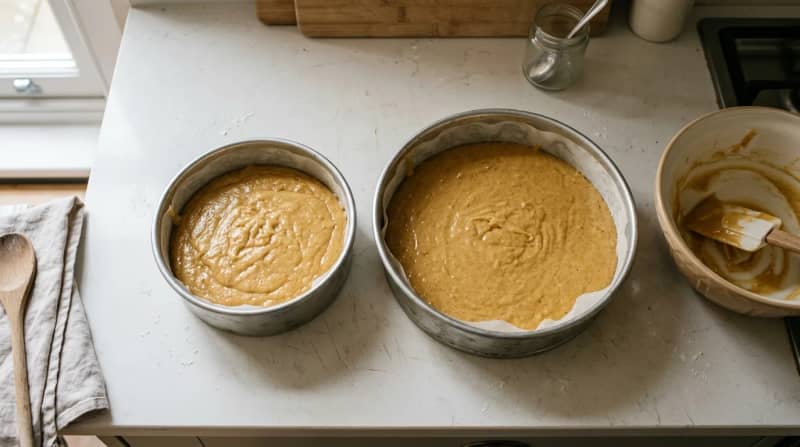
There is no dependable rule such as adding a fixed number of minutes for every centimetre of extra depth. Cake recipes contain different amounts of fat, sugar, liquid and raising agents, and ovens behave differently too.
Use the original baking time as a point of reference. If your cake is shallower than intended, start checking it sooner. If it is deeper, expect that it may need longer.
Changing tin size alone is not a good reason to automatically change the oven temperature. When preparing your new tin, make sure you know how to line a cake tin properly to protect the edges during a longer bake and ensure the cake releases cleanly.
Some tins need more than a base-area calculation
For a straightforward sponge in two similar straight-sided tins, area scaling is often enough.
There are cases where it should only be treated as a rough guide.
Very deep cake tins
If one tin is much deeper than the other, total capacity becomes more important.
Two tins can have similar base areas but very different volumes.
Loaf tins
Loaf tins vary considerably in length, width, depth and slope. Two products both described as a standard loaf tin may not actually hold the same amount.
If the manufacturer gives a capacity, that can be more useful than relying on length alone.
Bundt and shaped tins
A Bundt tin has a central tube, while decorative moulds can have curves and narrow sections. Simple base-area maths does not describe those shapes very well.
Capacity is usually a better comparison.
Cheesecakes and delicate sponges
Some recipes depend heavily on a particular depth and gentle, even cooking. Scaling the ingredients may work mathematically but still change the texture or baking behaviour.
When a recipe specifically recommends a certain tin size for structural reasons, staying fairly close to it is the safer choice.
Do not fill the replacement tin to the rim
After scaling a recipe, look at the batter in the tin before it goes into the oven.
Cake mixture needs space to rise.
There is no single filling percentage that works for every cake. A dense fruit cake, a light sponge and a heavily aerated mixture can rise very differently.
The original recipe is your best clue. If you know roughly how deep the batter normally sits in the intended tin, try to recreate a similar depth in the replacement.
If you end up with more mixture than the tin can safely take, it is better to bake the spare batter separately than to force everything into an overfilled tin.
Once it is baking, look at the cake rather than the clock
Changing the tin means the printed baking time is no longer something to follow blindly.
For a typical sponge cake, useful signs can include:
- the centre looking set rather than wet or glossy
- the surface springing back gently when lightly pressed
- a skewer coming out without wet raw batter, when that test suits the recipe
- the edges beginning to come slightly away from the side of the tin
No single test works for every bake.
Brownies and intentionally moist cakes, for example, may still leave soft crumbs on a skewer when they are ready. A dark top does not guarantee that a deep cake has baked through in the centre either.
The type of cake should decide which signs you trust.
If the outside has coloured well but the middle is still clearly underbaked, that is useful information for next time. The batter may have been deeper than the original recipe intended, or your tin may simply need a longer bake. If you find your cake collapsing as it cools, explore our troubleshooting guide on why cakes sink in the middle.
The safest way to resize a cake recipe
First compare the base area of the original tin with the one you want to use. Divide the new area by the old area, then multiply the ingredients by that scaling factor.
After that, use the numbers as a starting point rather than a promise.
Check how deep the batter actually sits in the new tin, leave enough room for it to rise, and adjust your baking checks to suit the new shape and depth.
The calculation helps you put the right amount of mixture in the tin. Watching how the cake behaves in your own oven finishes the job.
Useful Tools for this Guide
- Use Tool: Cake Tin Conversion Calculator
Cake Tin Conversion Calculator
Resize cake recipes for different round, square, loaf and rectangular tins in cm or inches.