
Breakfast
Easy Overnight Oats with Milk and Yoghurt
- Prep
- 5 min
- Total
- 8 hr 5 min
- Serves
- 2
Introduction
Overnight oats are rolled oats soaked in cold milk and yoghurt until they soften into a thick, spoonable breakfast. The method is five minutes of stirring the night before and nothing in the morning — the fridge does the work. For liquid volume conversions, use Cooking Volume Converter. For ingredient-specific cup and weight estimates, use Cups to Grams Converter. For related guidance, read How to Store Cakes, Biscuits and Bakes Properly.
The trade-off is a shift in taste. Hot porridge is cosy and nutty from the heat; chilled oats are milder, with a cool, pudding-like body from the yoghurt. If you expect them to taste like porridge, they will not. If you take them on their own terms, they are one of the easiest make-ahead breakfasts you can keep in a British fridge.
The quantities below make two jars, eaten over the next morning and the one after.
Related recipes
 Blueberry Oatmeal Muffins (Hearty, Not Heavy)Blueberry oatmeal muffins made with rolled oats, buttermilk, cinnamon and fresh blueberries for a soft, tender crumb.
 Classic Ham and Cheese OmeletteA classic ham and cheese omelette needs little more than eggs, cooked ham and melting cheese. Keeping the pan over medium-low heat helps the eggs stay soft and tender while the filling warms through.
What You'll Need
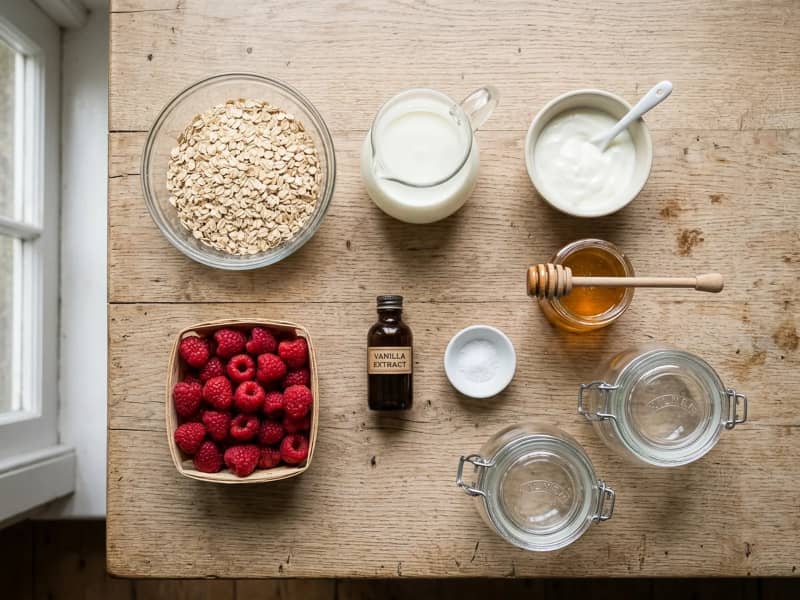
Ingredients
For two jars (one per morning)
- 160g rolled porridge oats (two 80g portions)
- 300ml whole milk
- 150g natural plain yoghurt
- 1 tbsp runny honey or maple syrup (optional)
- ½ tsp pure vanilla extract (optional)
- A small pinch of fine sea salt
For the morning
- A handful of fresh berries, sliced banana, chopped apple or any topping you like
Rolled porridge oats are the right oat for this method. They sit between quick oats, which collapse into paste after a night in milk, and jumbo or pinhead (steel-cut) oats, which stay chewy because they have not been rolled thin enough to drink in liquid cold. Any supermarket own-label porridge oats work. Oats are also where coeliacs need to read the packet: standard oats share production lines with wheat, so look for packets marked gluten-free if that matters at your table.
Whole milk gives the creamiest result; semi-skimmed is lighter and still fine. Natural plain yoghurt, Greek-style or ordinary set, loosens into the milk and gives the oats a mild tang. Honey is a sweetener for adults and children over one; the NHS advises against giving honey, raw or cooked, to babies under their first birthday because of the small risk of infant botulism. Maple syrup is the easy swap for a baby or a vegan jar.
How to Make Easy Overnight Oats with Milk and Yoghurt
| Soak time | Result |
|---|---|
| 4 hours | Chalky centre, looser outside — fine in an emergency |
| 8 hours | Evenly softened throughout — the recommended minimum |
| 12–16 hours | About the same as 8 hours; oats stop absorbing much more after ~10 hours |
Mix, Chill and Finish
-
Set out two clean jars or lidded tubs with a capacity of about 350–400ml each; a 300ml jar fills to the brim and spills when you stir in the morning. Spoon 80g of rolled porridge oats into each jar.
-
Divide the milk between the jars (about 150ml each), then spoon in half the yoghurt (about 75g each). Add half of the honey or maple syrup, half of the vanilla and a very small pinch of salt to each jar. Salt is not for seasoning here; it brings out the oats' flavour the way a pinch does in porridge.
-
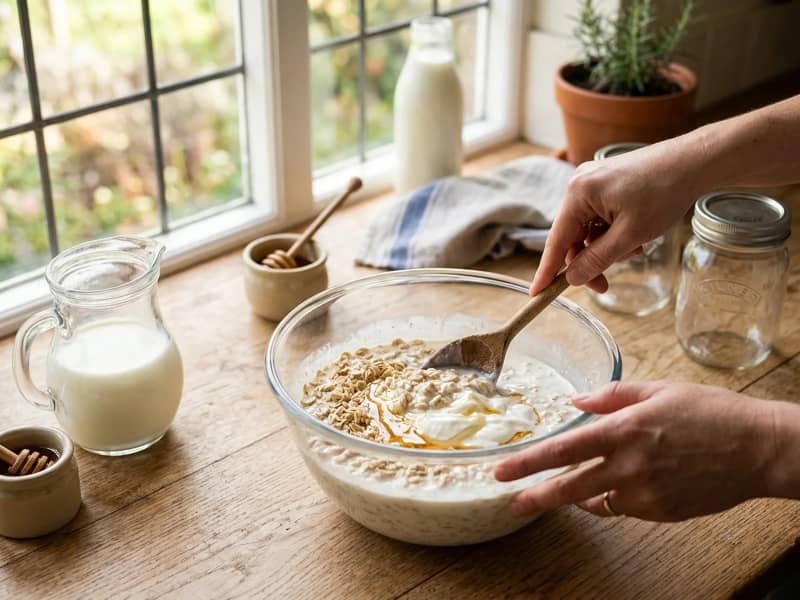
Stir each jar with a long spoon or the handle of a wooden spoon, right down to the bottom, until the yoghurt has disappeared into the milk and no dry pockets of oats remain at the base. The mixture looks loose — somewhere between pouring cream and thick custard — because the oats have not started to absorb the liquid yet.
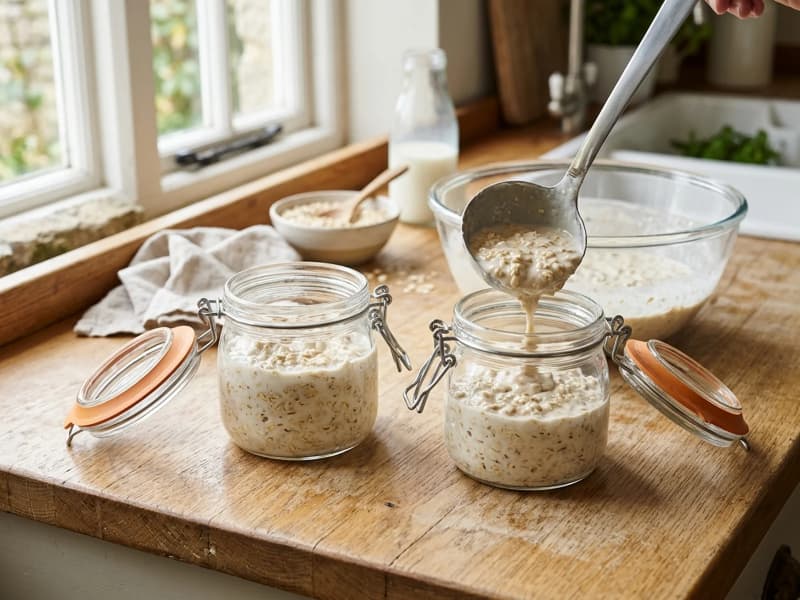
 4. Put the lids on and refrigerate for at least 8 hours, and ideally overnight. The oats need the full time to soften evenly; four hours leaves a chalky centre.
 5. In the morning, lift a jar out of the fridge and give it a stir. The oats will have thickened to a soft, spoonable mixture. If it looks too thick for your taste, splash in a tablespoon of milk at a time, stirring between each addition, until it loosens. If it looks too thin, stir in another tablespoon of oats and give it ten minutes to catch up — they soften quickly in the already-cold mixture.
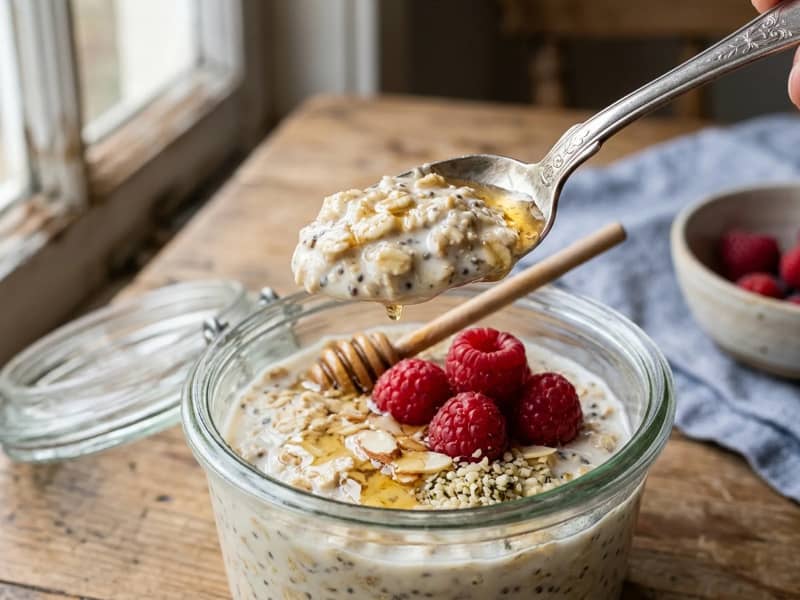 6. Top with fresh fruit or whatever you fancy and eat straight away. Toppings go on in the morning, not the night before: berries bleed red juice into the oats, bananas turn grey around the edges, and apples brown. The oats underneath are still fine, but they look tired.
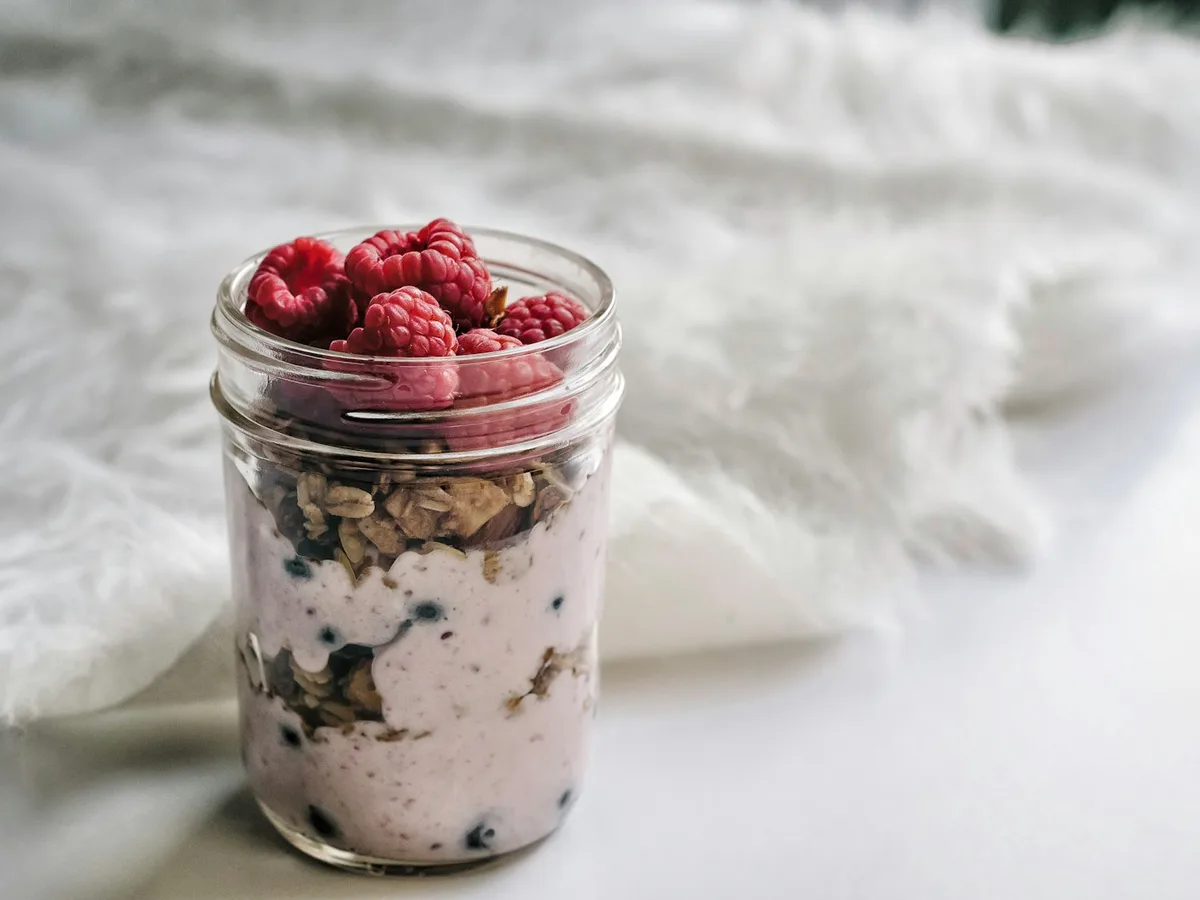
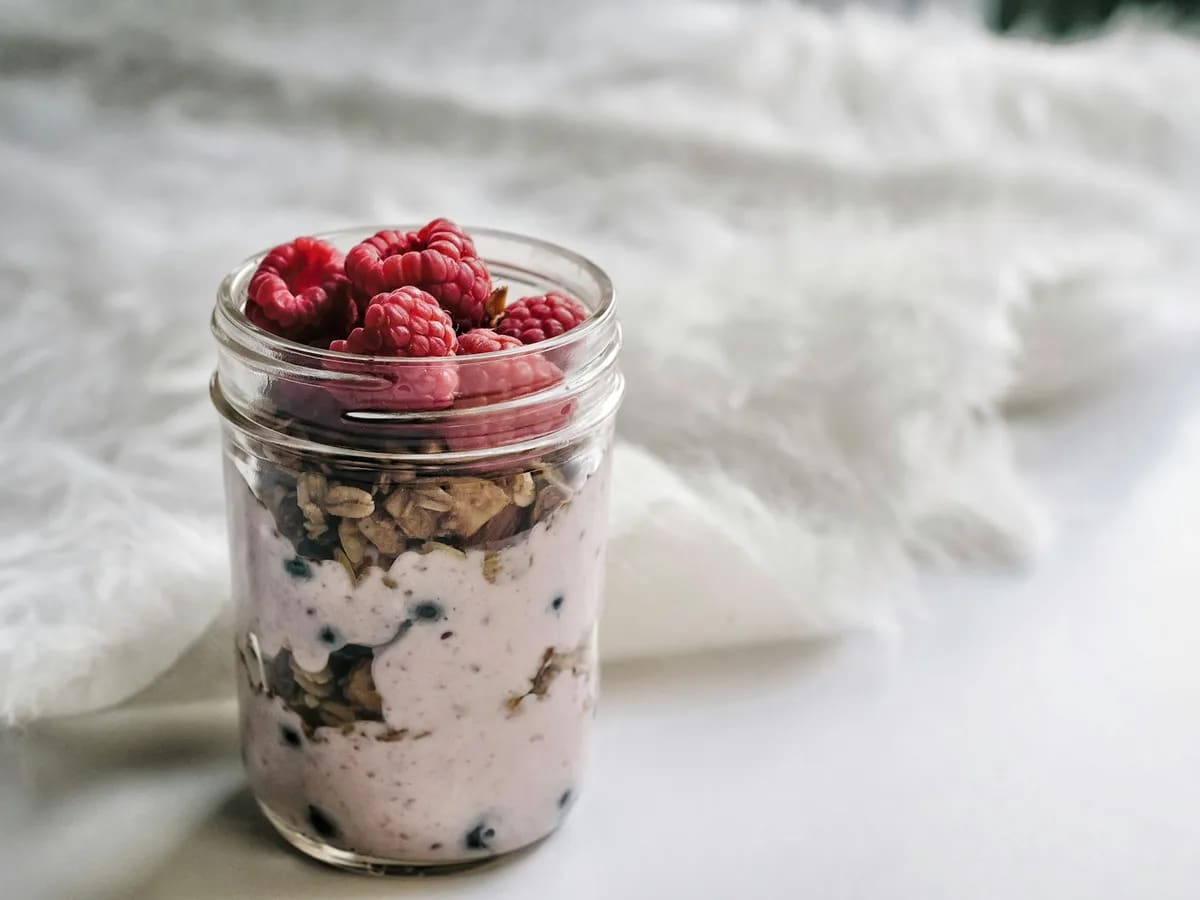
Rolled oats are soaked overnight in milk and yoghurt until soft, creamy and ready for breakfast. Add fresh berries, sliced banana or your favourite toppings in the morning for a convenient make-ahead meal with minimal preparation.
- Two 350–400ml clean glass jars with tight-fitting lids (or airtight containers)
- Kitchen scales (for accurate oat measurements)
- Measuring jug
- Long spoon for stirring
Adjust yield quantities or check items off as you prep.
- Set out two clean jars or lidded tubs with a capacity of about 350–400ml each; a 300ml jar fills to the brim and spills when you stir in the morning. Spoon 80g of rolled porridge oats into each jar.
- Divide the milk between the jars (about 150ml each), then spoon in half the yoghurt (about 75g each). Add half of the honey or maple syrup, half of the vanilla and a very small pinch of salt to each jar. Salt is not for seasoning here; it brings out the oats' flavour the way a pinch does in porridge.
- Stir each jar with a long spoon or the handle of a wooden spoon, right down to the bottom, until the yoghurt has disappeared into the milk and no dry pockets of oats remain at the base. The mixture looks loose — somewhere between pouring cream and thick custard — because the oats have not started to absorb the liquid yet.
- Put the lids on and refrigerate for at least 8 hours, and ideally overnight. The oats need the full time to soften evenly; four hours leaves a chalky centre.
- In the morning, lift a jar out of the fridge and give it a stir. The oats will have thickened to a soft, spoonable mixture. If it looks too thick for your taste, splash in a tablespoon of milk at a time, stirring between each addition, until it loosens. If it looks too thin, stir in another tablespoon of oats and give it ten minutes to catch up — they soften quickly in the already-cold mixture.
- Top with fresh fruit or whatever you fancy and eat straight away. Toppings go on in the morning, not the night before: berries bleed red juice into the oats, bananas turn grey around the edges, and apples brown. The oats underneath are still fine, but they look tired.
Make It Ahead and Freeze
- Making ahead
- The Food Standards Agency has no guidance written specifically for overnight oats. Its general rule for leftovers — eat them within 48 hours and keep the fridge between 0 and 5°C — is the figure to work to here, because the jar is a cold, mixed, dairy-based dish once the yoghurt and milk go in. Several American and European food blogs quote three to five days, which is longer than UK leftover guidance supports, so stick to two days unless your yoghurt pot's own date gives you a reason to go further.
- Scaling up
- Two jars is a comfortable batch for one person over two mornings. For a family week, make two jars at a time rather than six at once: the texture of the oats drifts from soft on day one to soft-and-slightly-looser on day two, and the fourth or fifth day crosses the FSA's two-day line.
- Freezing
- Overnight oats freeze poorly. The water in the dairy forms ice crystals that break the texture, and the thawed jar is grainy and watery rather than creamy. If you have a jar you cannot eat in time, use it in porridge the next morning: tip the contents into a saucepan with a splash more milk and warm it through.
How to Reheat Easy Overnight Oats with Milk and Yoghurt
Cold is the default and the method the fridge sets you up for, but a warm jar is easy on a cold morning.
In the microwave. Tip the oats into a microwave-safe bowl — glass jars often warm unevenly and can crack if the fridge-cold glass meets a hot centre. Add a tablespoon of milk, cover loosely and heat on medium (around 450 to 600 watts) for 60–90 seconds, stirring at the halfway mark so the sides do not scorch while the middle is still cold.
On the hob. Scrape the jar into a small saucepan, add 2–3 tablespoons of milk and warm over a low heat for 3–4 minutes, stirring often, until it steams but does not boil. A hard boil breaks the yoghurt and turns the texture gritty.
Reheat only the portion you plan to eat. The FSA advises reheating leftovers only once, so take out one jar and leave the other cold.
Toppings and Variations
- Classic berry
- 50g of fresh raspberries or blueberries, scattered on top, with a drizzle of honey. Frozen berries work too — scatter them on 10 minutes before eating and they thaw to softness.
- Banana and peanut butter
- Half a sliced banana and a teaspoon of smooth peanut butter stirred through the top layer. The banana sweetens the jar without any added sugar.
- Apple and cinnamon
- Half a grated eating apple folded in with ¼ tsp of ground cinnamon. A grated apple holds up overnight; a diced one browns.
- Chocolate
- Stir 1 tsp of good cocoa powder into the base before chilling, and top with chopped dark chocolate in the morning.
- Higher protein
- Replace 50g of the yoghurt with Greek-style yoghurt and stir in a tablespoon of smooth almond butter.
- Chia-thickened
- Add 1 tbsp of chia seeds to each jar and increase the milk by 50ml. Chia seeds swell as they absorb liquid, so without the extra milk the jar sets too stiff.
- Dairy-free
- Use any plant-based milk — oat, almond or soya — and a dairy-free natural yoghurt. Oat milk gives the result closest to whole dairy; almond milk is the thinnest and benefits from the chia-thickened variation above. Swap honey for maple syrup.
- No sweetener
- Leave out the honey or maple syrup. A ripe banana or a scattering of raisins on top does the sweetening job.
- For a baby over 6 months
- Mash well, leave out the honey, and use maple syrup or just a ripe banana. Check with your health visitor about introducing cow's milk and oats if these are new foods.
Tips for the Best Results
- Match the jar to the amount
- A 350–400ml jar leaves enough room to stir without spilling. A 300ml jar fills to the brim and overflows the moment the spoon goes in.
- Pick the right oats
- Standard rolled porridge oats are the right thickness. Quick oats disappear into mush overnight; jumbo or pinhead oats stay chewy. If the packet says "porridge oats" and the flake is thinner than a 5p coin, it will work.
- Fix the texture in the morning, not the night before
- The jar is loose when it goes into the fridge and thick when it comes out. If you add extra liquid the night before "just in case", you get soup. Make the ratio call in the morning with a splash of milk or a spoonful of oats.
- Keep the pinch of salt
- Oats without salt taste flat, warm or cold. A single pinch per jar is all it takes.
- Toppings in the morning
- Berries, banana, apple and anything else fresh go on at the last minute. The dry oats and dairy mixture is what the fridge keeps well; a berry sitting in the mix all night loses its colour and texture.
- Treat the chia-seed route as a different recipe
- Chia seeds thicken anything they sit in, so a chia jar is firmer and more pudding-like. Add the extra 50ml of milk at the start, not the morning after, because by then the seeds have already set.
- Jar in the door of the fridge is colder than a jar at the back
- If your jars are regularly firmer than the ones in cookery videos, that is why. The front shelves hover closer to 5°C and the back of the fridge sits closer to 2°C, which is where dairy slows down.
Frequently Asked Questions
- How long do overnight oats actually keep in the fridge?
- Treat two days as the ceiling in a British fridge set between 0 and 5°C. The FSA has no overnight-oats-specific figure, but the agency's general leftover guidance is 48 hours from the moment the jar was mixed. A yoghurt pot date later than two days from your mixing time does not override that; the yoghurt was pasteurised in a sealed pot, and a stirred, open jar is less protected.
- My oats are slimy. What went wrong?
- Three usual causes. Too much stirring in the morning releases the starch from the oats, which turns the jar glossy and gluey — stir only enough to loosen it. Quick oats or very fine supermarket oats give the same effect by breaking down overnight. And a chia-seed addition without the extra milk sets to a jelly, which is what people usually mean by "slimy" when they tried a Pinterest recipe. Use rolled porridge oats, stir once in the morning, and if you want chia, add the extra 50ml of milk at the start.
- Can I eat overnight oats warm?
- Yes. Tip them into a bowl, add a splash of milk and microwave on medium for 60–90 seconds, stirring halfway, or warm them on the hob over a low heat. The result sits between overnight oats and porridge: thicker than porridge because the oats were already fully soaked, and milder in flavour than porridge made from scratch.
- Can I use water instead of milk and yoghurt?
- You can, but the result is flat and sour-tasting rather than creamy. Water carries none of the fat that gives the jar body, and the acidity of the yoghurt is what softens the oats most quickly. If dairy is the issue, swap to oat milk and a dairy-free yoghurt; if calories are the issue, use semi-skimmed milk and a low-fat natural yoghurt.
- Why does the ratio in different recipes vary so much?
- Rolled oats are not standardised. One brand's oats are thicker, one is thinner, one is more polished and absorbs liquid faster. The 80g of oats to 150ml of milk plus 75g of yoghurt in this recipe lands in the middle of what most UK brands handle well. If you prefer a very loose, drinkable breakfast, add another 50ml of milk per jar; for a firm, pudding-like set, drop the milk by 25ml.
- Do I have to soak them overnight, or will four hours do?
- Eight hours is the point at which the oats soften evenly through. Four hours leaves a chalky core and a looser outside — fine in an emergency, better the longer you leave it. Twelve or sixteen hours is also fine; the oats stop absorbing much after about ten hours and sit at the same thickness.



Reviews (0)