
Baking
Classic Victoria Sponge Cake with Jam and Cream
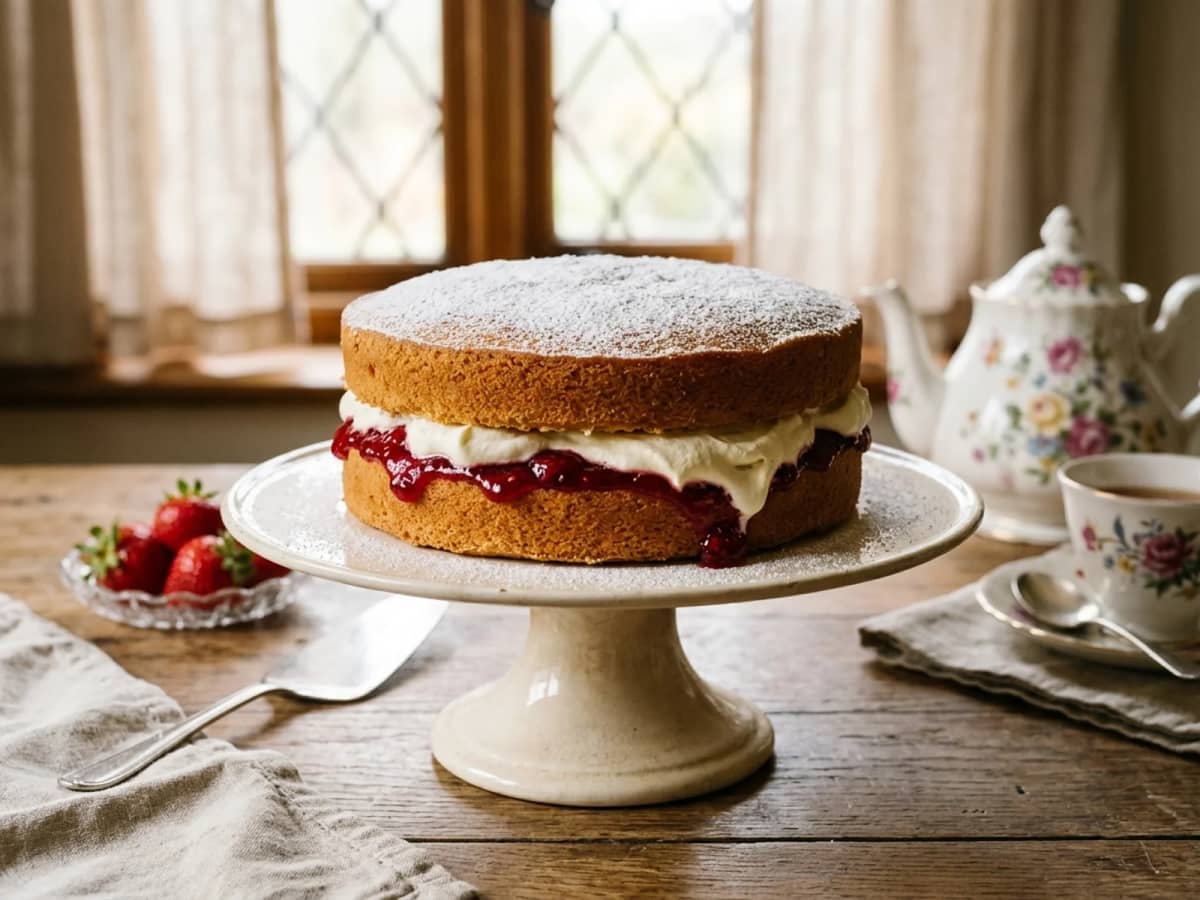
- Prep
- 25 min
- Cook
- 25 min
- Total
- 1 hr 40 min
- Serves
- 8
Introduction
Two layers of soft butter sponge are sandwiched with strawberry jam and whipped double cream, then finished with a dusting of icing sugar. The sponge uses equal weights of butter, caster sugar and self-raising flour, with four large eggs, which is the classic ratio behind this cake. If you are considering a different tin size, check Cake Tin Conversion Calculator. If adding buttercream, estimate the quantity with Buttercream & Frosting Quantity Calculator. For related guidance, read How to Tell When a Cake Is Fully Baked.
Allow about 1 hour 40 minutes in all: 25 minutes to prepare, 25 minutes to bake and about 50 minutes to cool the layers before filling. It serves eight to ten.
Related recipes
 Easy Banana Loaf (The banana loaf with the blackest bananas)A simple homemade banana loaf made with very ripe bananas, brown sugar and sour cream or yoghurt for a soft, moist crumb. No mixer is needed, making it an easy way to use up heavily spotted bananas.
 British Ginger Cake Recipe – Moist, Sticky & EasyA moist, sticky British ginger cake with warm spices and a rich flavour, perfect with a cup of tea.
What You'll Need
Equipment
- Two 20cm (8in) sandwich tins, at least 4cm deep
- A hand whisk or stand mixer
- A fine grater or Microplane (not needed here, but useful if you add zest)
- A wire rack
- A palette knife, for spreading the cream
- A fine sieve, for dusting the top with icing sugar
Ingredients
For the sponge
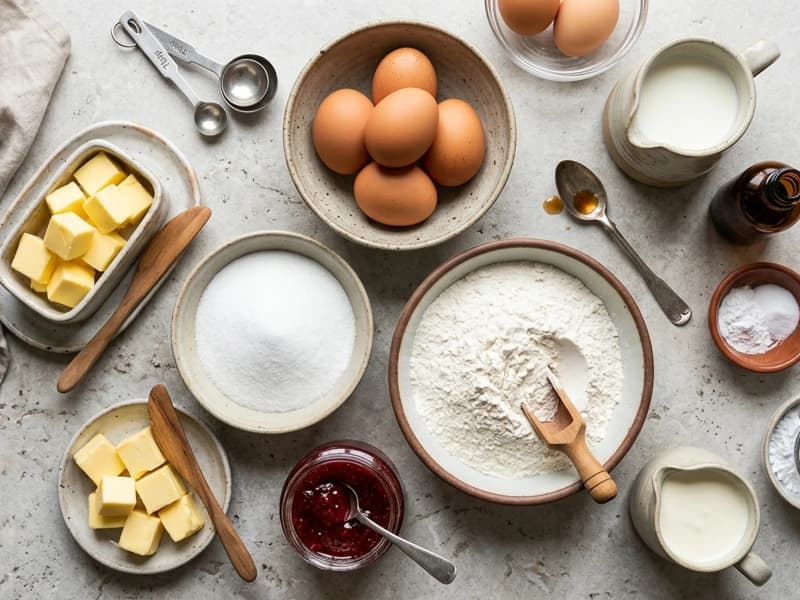
- 225g unsalted butter, at room temperature
- 225g caster sugar
- 4 large eggs, at room temperature
- 225g self-raising flour
- 1 tsp baking powder
- 2 tbsp whole milk
- 1 tsp pure vanilla extract
For the filling and top
- 4 tbsp strawberry jam (about 120g)
- 250ml double cream, well chilled
- 1–2 tsp icing sugar, for dusting
Soft butter creams more smoothly than fridge-cold butter, and eggs at room temperature are less likely to curdle the batter. Caster sugar dissolves more quickly than granulated, which gives a finer crumb. A thick-set strawberry jam spreads neatly and does not run into the cream; raspberry jam works just as well and is the traditional Women's Institute choice. For the finish, icing sugar gives the modern, snowy look used by many published recipes, but a dusting of caster sugar is the WI convention; use either.
How to Make Victoria Sponge Cake
Prepare the Tins and Oven
- Heat the oven to 180°C (160°C fan/gas 4) with a shelf in the middle. Grease the sandwich tins and line the bases with discs of baking parchment.
Make the Batter
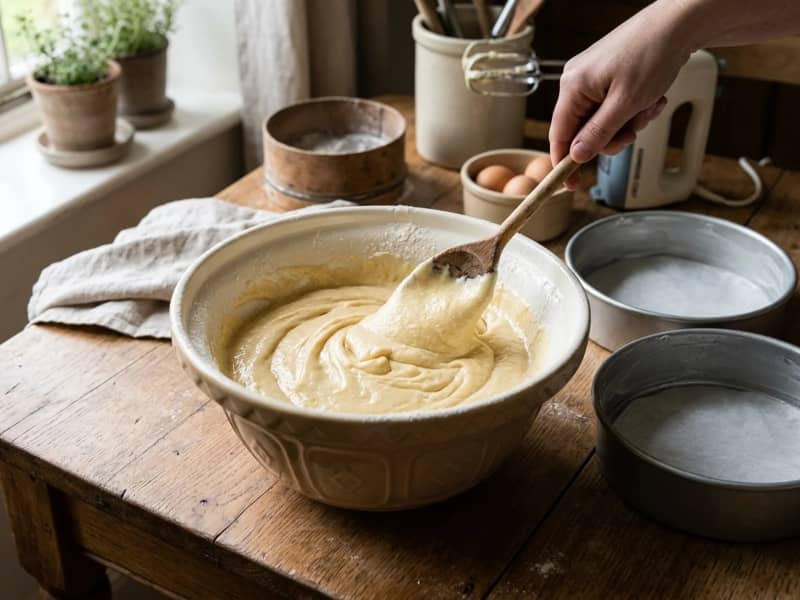
- In a large bowl, cream the softened butter and caster sugar together with an electric whisk for 3–4 minutes, until pale and fluffy. The mixture should look noticeably lighter in colour before you move on.
- Beat in the eggs one at a time, adding a tablespoon of the flour with each egg to stop the mixture splitting. Stir in the vanilla.
- Sift the rest of the flour and the baking powder over the batter and fold it in gently with a large spoon or spatula, in a figure-of-eight motion. Stir in the milk, just enough to loosen the batter so it falls off the spoon easily.
Bake, Cool and Fill
- Divide the batter evenly between the two tins; a kitchen scale makes this easier. Level the tops, then make a small, shallow dip in the centre of each so the cakes rise flat rather than domed. Bake on the middle shelf for 20–25 minutes.
- The sponges are ready when they are risen, golden brown, springy to a light press in the centre, and starting to pull away from the sides of the tins. A skewer pushed into the middle should come out clean or with just a few moist crumbs. Do not open the oven door before 20 minutes.
- Leave the sponges in their tins for 5 minutes, then run a knife round the edge and turn them out onto a wire rack. Peel off the parchment and leave the layers to cool completely, which takes about 45 minutes. The cakes must be fully cool before they are filled, or the cream will melt.
- When the sponges are cool, whip the double cream in a chilled bowl, with a hand whisk or electric whisk, until it holds soft peaks. Stop before it looks grainy; over-whipped cream splits and will not spread smoothly.
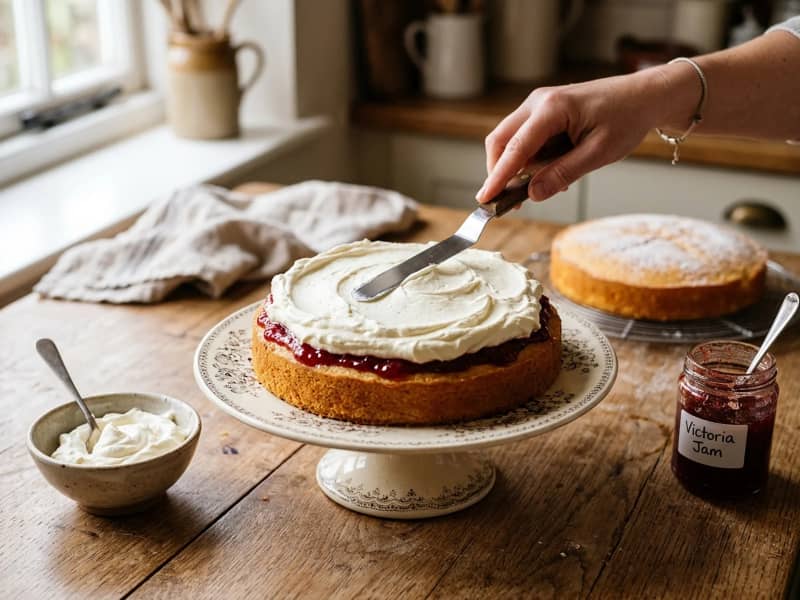
- Put the first sponge on a serving plate, bottom side up for a flat surface, and spread the jam evenly over it, leaving a 1cm border. Spoon the whipped cream over the jam and spread it level. Set the second sponge gently on top. Dust with icing sugar through a fine sieve just before serving.
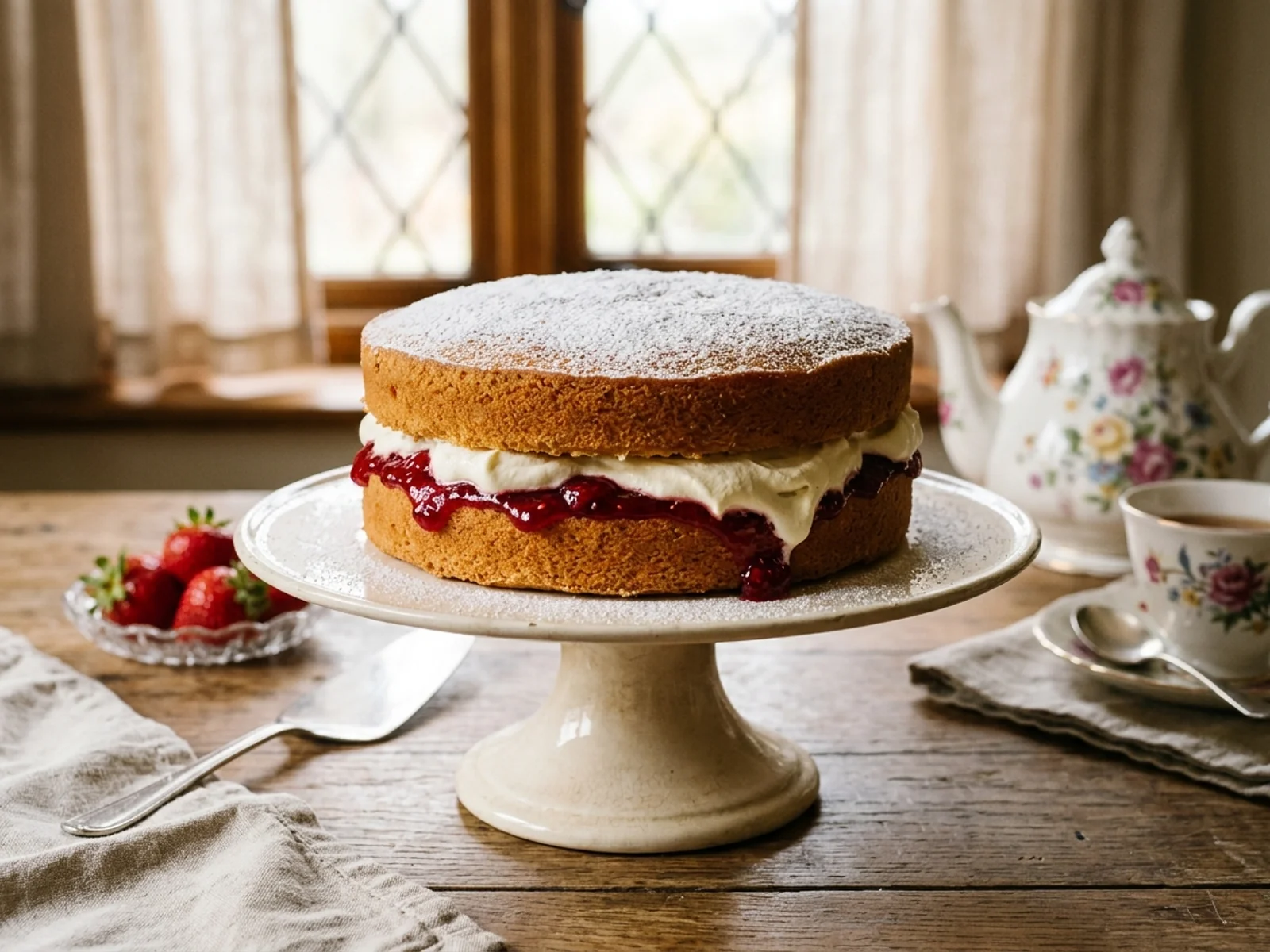
Two soft, buttery sponge layers are sandwiched together with strawberry jam and freshly whipped cream. This classic Victoria sponge is a much-loved British teatime cake, with a light texture and a simple finishing dusting of icing sugar.
- 2 × 20cm round sandwich tins, greased and base-lined with baking parchment
- Electric hand mixer or stand mixer with paddle attachment
- Large mixing bowl
- Fine sieve
- Large metal spoon or silicone spatula (for gentle folding)
- Wire cooling rack
- Palette knife or flat-bladed knife
Adjust yield quantities or check items off as you prep.
- Heat the oven to 180°C (160°C fan/gas 4). Grease two 20cm sandwich tins and line the bases with parchment.
- Cream the softened butter and caster sugar for 3–4 minutes until pale and fluffy.
- Beat in the eggs one at a time, each with a tablespoon of the flour, then stir in the vanilla.
- Sift and fold in the rest of the flour and the baking powder, then stir in the milk until the batter drops easily off the spoon.
- Divide between the tins, level and dip the centres, and bake for 20–25 minutes.
- Check: risen, golden, springy and pulling from the sides; a skewer should come out clean.
- Rest 5 minutes in the tins, then turn out onto a wire rack and leave to cool completely, about 45 minutes.
- Whip the chilled double cream to soft peaks.
- Spread jam over the first sponge, spoon the cream over, add the second sponge and dust with icing sugar.
Tips for the Best Results
- Weigh the ingredients. Baking is more forgiving when the quantities are precise. A kitchen scale is more accurate than cups for butter, sugar and flour.
- Soften the butter properly. Butter straight from the fridge will not cream; melted butter gives a dense cake. Leave the butter out of the fridge for an hour or two before you start.
- Add flour with the eggs. A tablespoon of flour with each egg stops the fat and water in the eggs from separating.
- Fold the flour in gently. Heavy stirring at this stage knocks out air. A few folds in a figure-of-eight motion is enough.
- Divide the batter evenly. Weighing the tins before you add the batter, then weighing the full tins, is the easiest way to make sure the two layers come out the same height.
- Dip the batter in the centre. A shallow hollow in the middle of each tin encourages a flat top, so you do not need to trim the cakes.
- Do not open the oven door early. A rush of cold air can make the sponges sink. Trust the time and the springback test.
- Cool completely before filling. Even slightly warm sponge will melt the cream and soften the top layer, so wait until the cakes feel cold.
How to Store and Freeze Victoria Sponge Cake
- Unfilled sponges, at room temperature
- The two cooled sponge layers, on their own, keep well in an airtight tin at room temperature for two to three days.
- Filled with cream, in the fridge
- Once the cream is in, the cake needs to go in the fridge. The Food Standards Agency (FSA) says household fridges should run at 5°C or below and treats 8°C to 63°C as the temperature range where bacteria grow most quickly. Keep the filled cake covered and eat it within one to two days. Bring it back to room temperature for 20 minutes before serving so the sponge does not feel dense.
- Make-ahead
- You can bake and cool the sponges a day ahead, wrap them tightly and keep them at room temperature. Whip the cream and assemble the cake within a few hours of serving, so it does not weep into the jam.
- Freezing
- Unfilled sponge layers freeze very well. Wrap each one in two layers of cling film, then foil, and freeze at around −18°C. The FSA sets no time limit for the freezer, but a few published recipes allow up to three months for best texture. Do not freeze the cake once it has been filled with cream, because cream separates on thawing.
- Defrosting
- Defrost unfilled sponges, still wrapped, in the fridge overnight or at cool room temperature for a few hours. The FSA says to use defrosted food within 24 hours.
- Where this applies
- This follows FSA guidance for England, Wales and Northern Ireland. Food Standards Scotland says defrosted food can be used within one to two days.
| State | Where | How long |
|---|---|---|
| Unfilled sponge layers | Airtight tin, room temperature | 2–3 days |
| Filled with cream | Fridge, covered | 1–2 days |
| Unfilled sponge layers | Freezer, wrapped | Up to ~3 months (FSA sets no formal limit) |
Substitutions and Variations
- Raspberry jam
- use 4 tbsp of raspberry jam in place of strawberry. This is the traditional Women's Institute version.
- Fresh berries
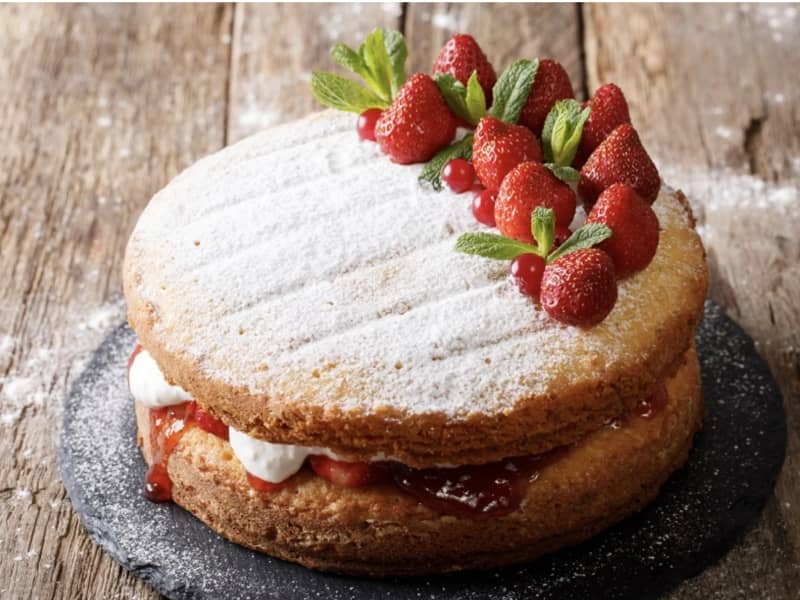
- scatter 100g of halved strawberries or whole raspberries over the cream before putting the top layer on.
- No cream (classic WI version)
- leave out the cream and dust the top with caster sugar instead of icing sugar. The cake will keep for two to three days at room temperature.
- Vanilla buttercream
- instead of whipped cream, make a buttercream with 100g of soft unsalted butter, 200g of icing sugar, 1 tsp of vanilla and 1 tbsp of milk, beaten until smooth.
- Baking spread instead of butter
- Mary Berry recommends a baking spread of at least 70% fat, used cold from the fridge in an all-in-one method. Beat all the sponge ingredients together for about two minutes, then divide and bake as described.
- Smaller 18cm tins
- scale the sponge ingredients down to 175g each of butter, sugar and flour, with 3 large eggs. The cake will be smaller but taller.
Frequently Asked Questions
- Why is my cake sunken in the middle?
- Opening the oven door before the sponge has set, an oven that is a little too cool, or too much baking powder can all cause a dip. Use an oven thermometer if you suspect your oven, measure the baking powder level and leave the door closed for at least 20 minutes.
- Why did my mixture split when I added the eggs?
- Cold eggs or butter that was too firm are the usual causes, and a tablespoon of flour added with each egg will often prevent it. If the batter does split, keep adding the eggs and flour; it will come together once the flour goes in.
- Why does my sponge dome rather than rise flat?
- A dip in the batter before baking, slightly cooler oven heat and spreading the batter to the edges all help. If a dome does form, trim it with a serrated knife, or set the bottom layer top-down so the flatter base of the top sponge finishes the cake.
- How do I keep the cream from making the jam run?
- Spread the jam first and leave a 1cm border, then spoon or pipe the cream over it rather than spreading. A thick-set jam helps too. Assemble the cake close to serving time, and if you need to make it ahead, keep it covered in the fridge.
- Why is this cake called a Victoria sponge?
- It is named after Queen Victoria, who is said to have eaten a jam-filled sponge at tea during her stays on the Isle of Wight. The earliest printed recipe is in Mrs Beeton's Book of Household Management from 1861, and the Women's Institute still bakes a strict version to this day — jam only, with caster sugar on top, no cream.



Reviews (0)